
Meissen
The origins of Meissen porcelain can be traced back to 1708, when Ehrenfried Walther von Tschirnhaus, a scientist and alchemist, began experimenting with porcelain. After Tschirnhaus's death in October of that year, Johann Friedrich Böttger, another alchemist, continued Tschirnhaus's work and brought the porcelain to market with the help of King Augustus the Strong of Poland and Elector of Saxony. The first porcelain in Europe was made using kaolin from Saxony, Germany.
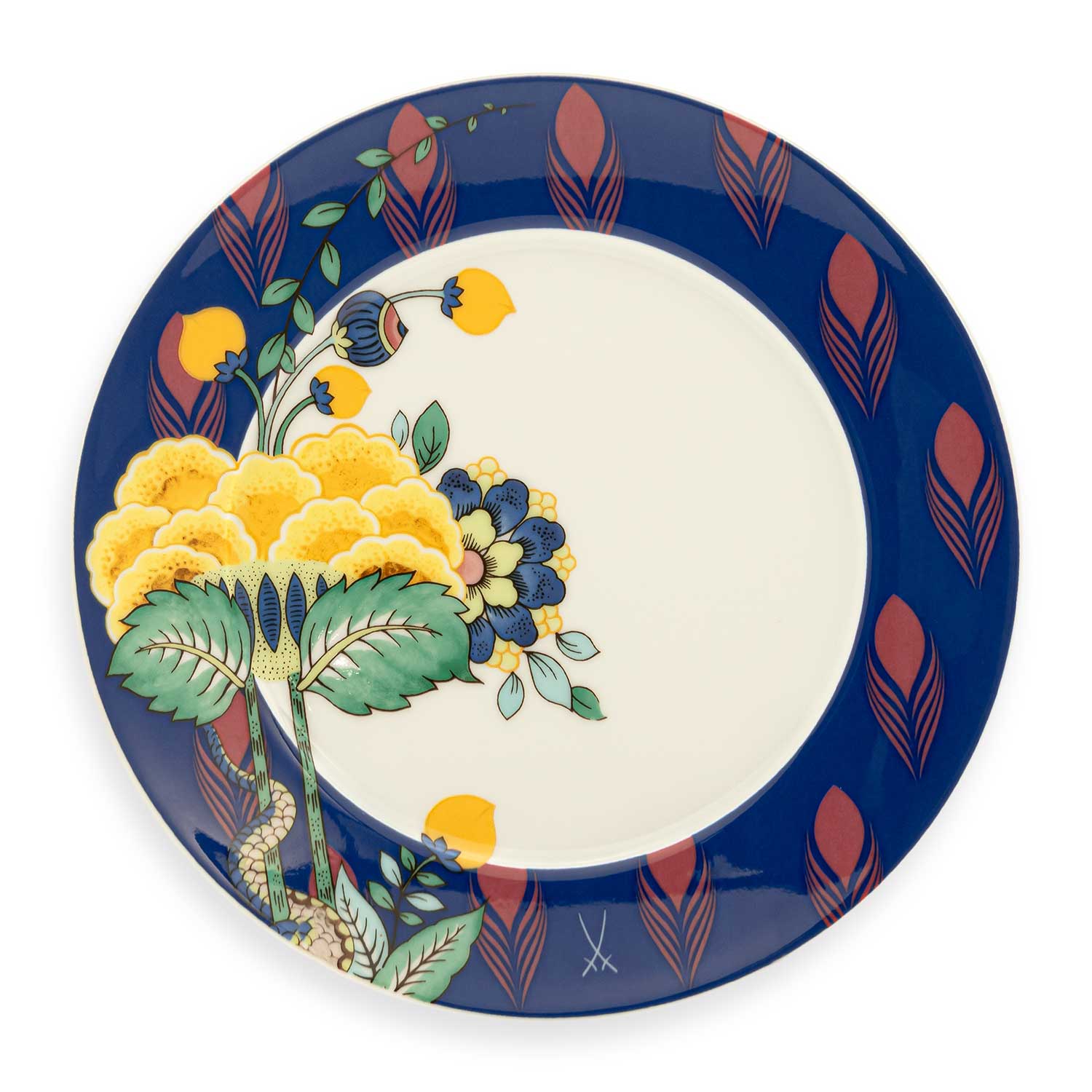
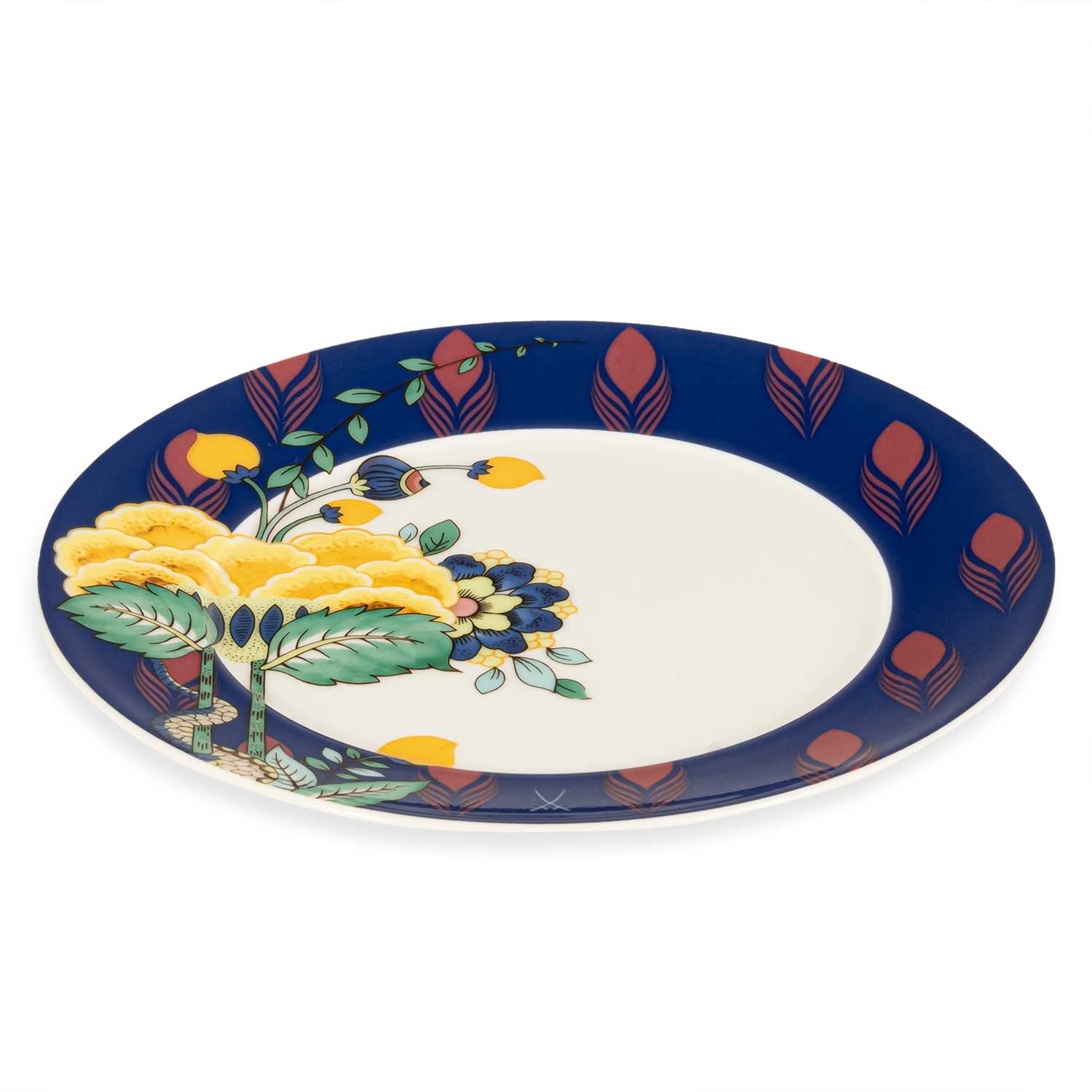
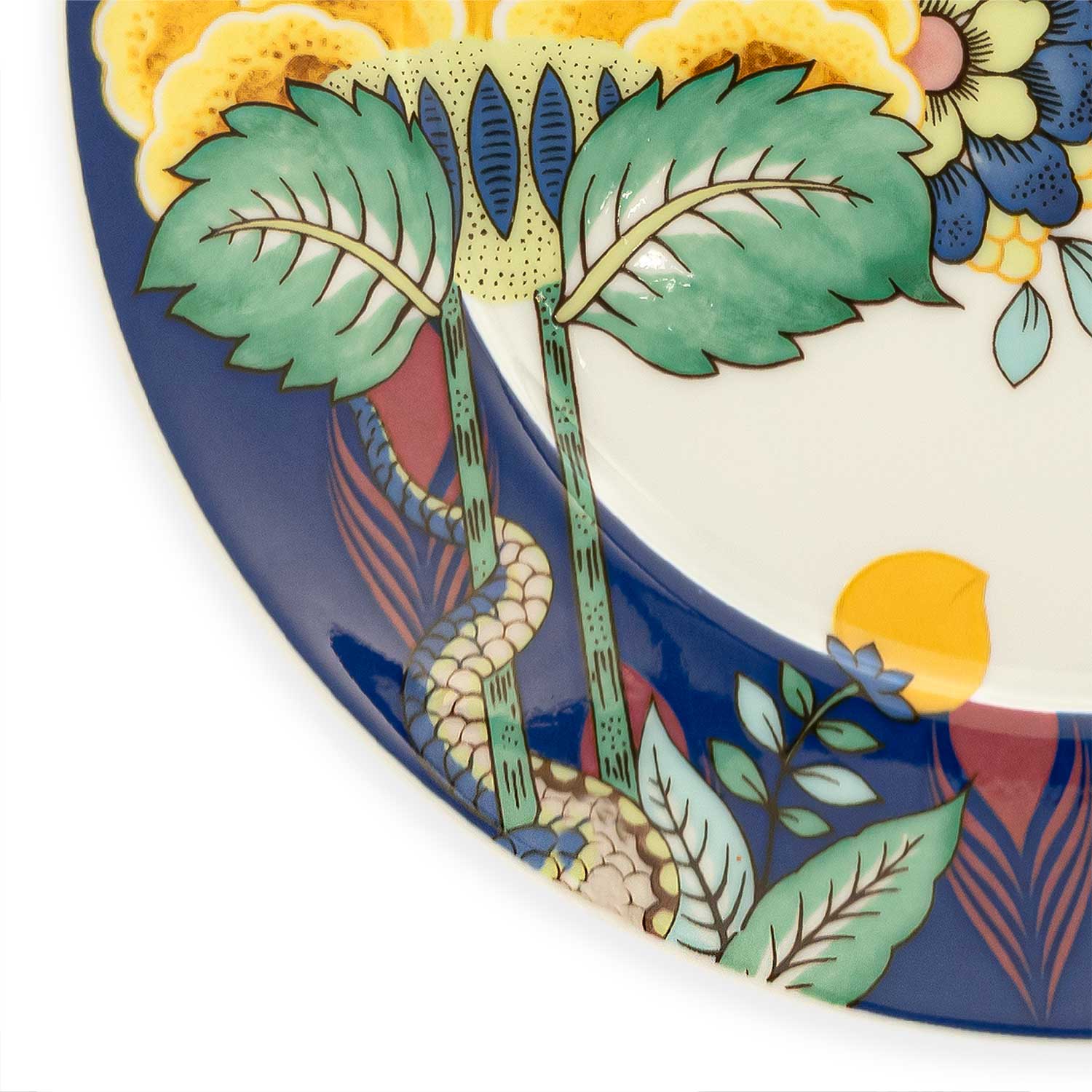
Bloomy Mystic Garden Bread and Butter Plate


Bloomy Feathers Presentation Plate
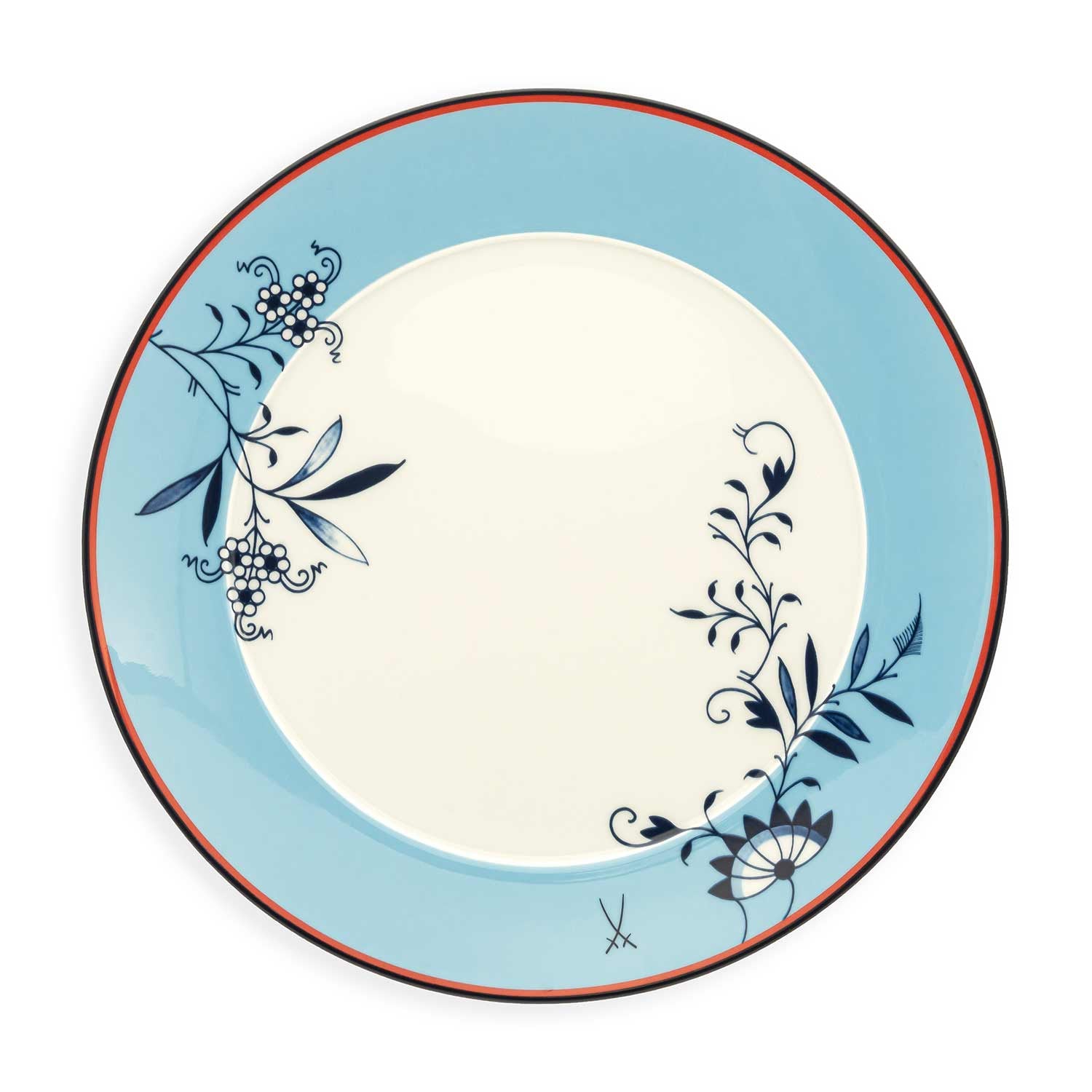
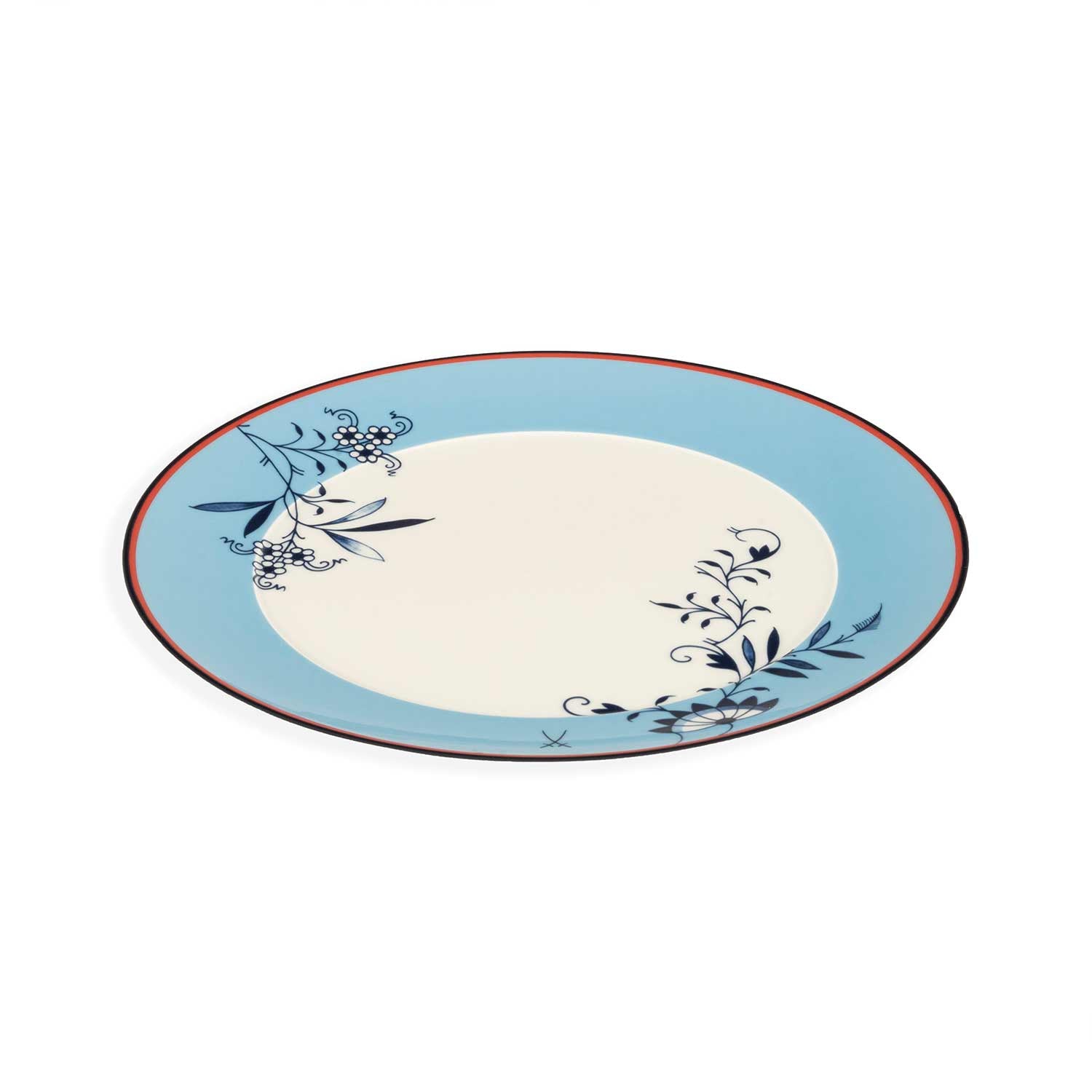
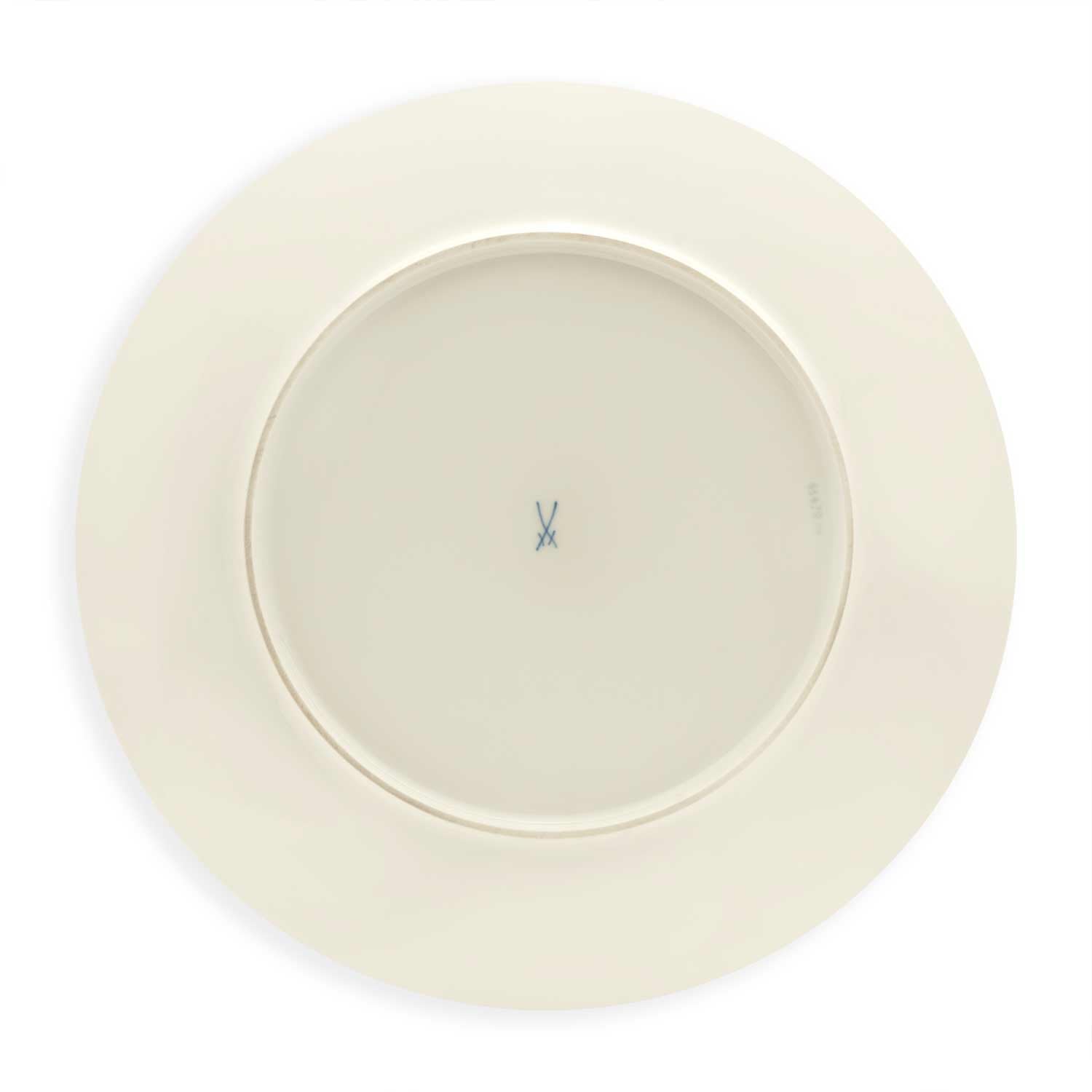
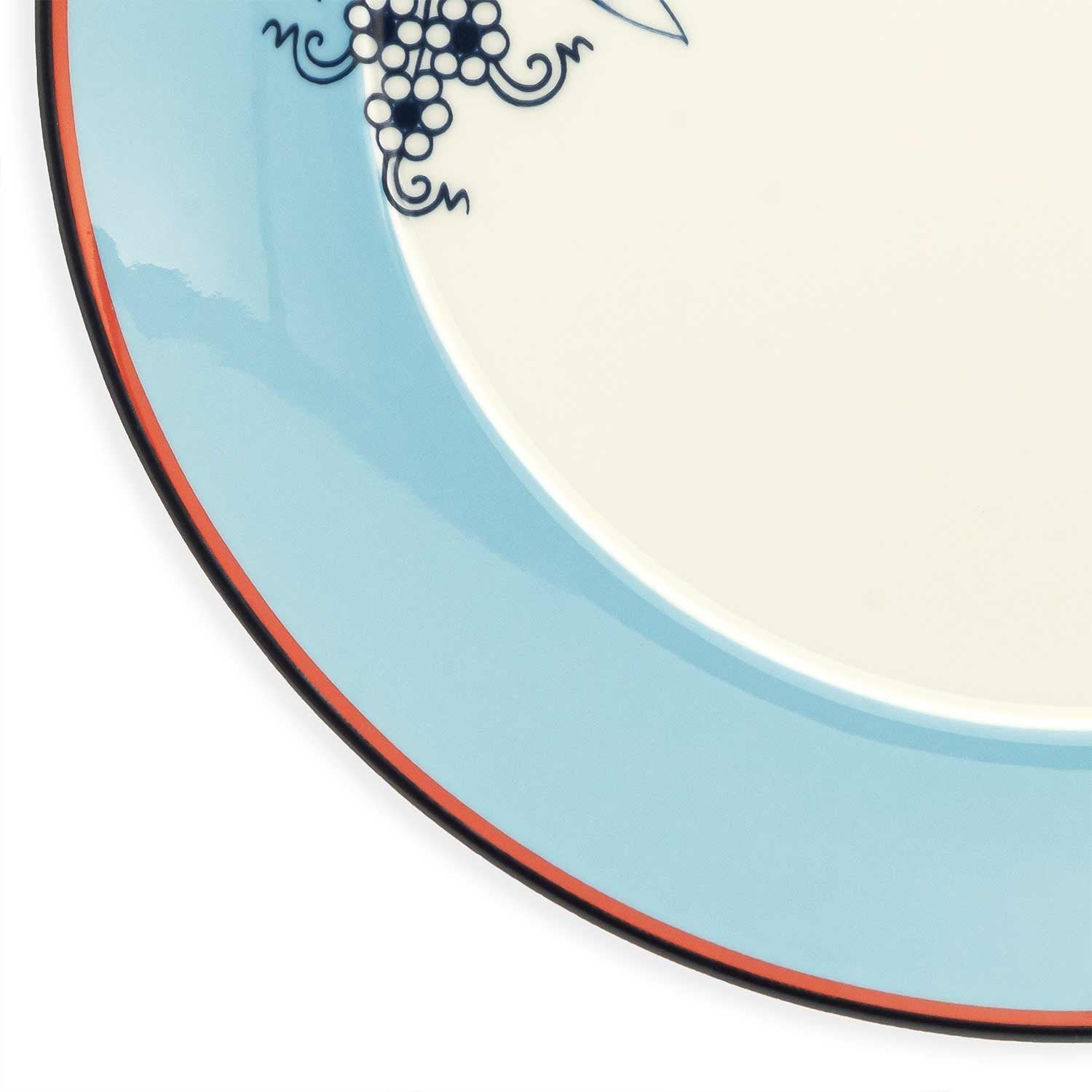
Bloomy Blue Grape Wine Dinner Plate
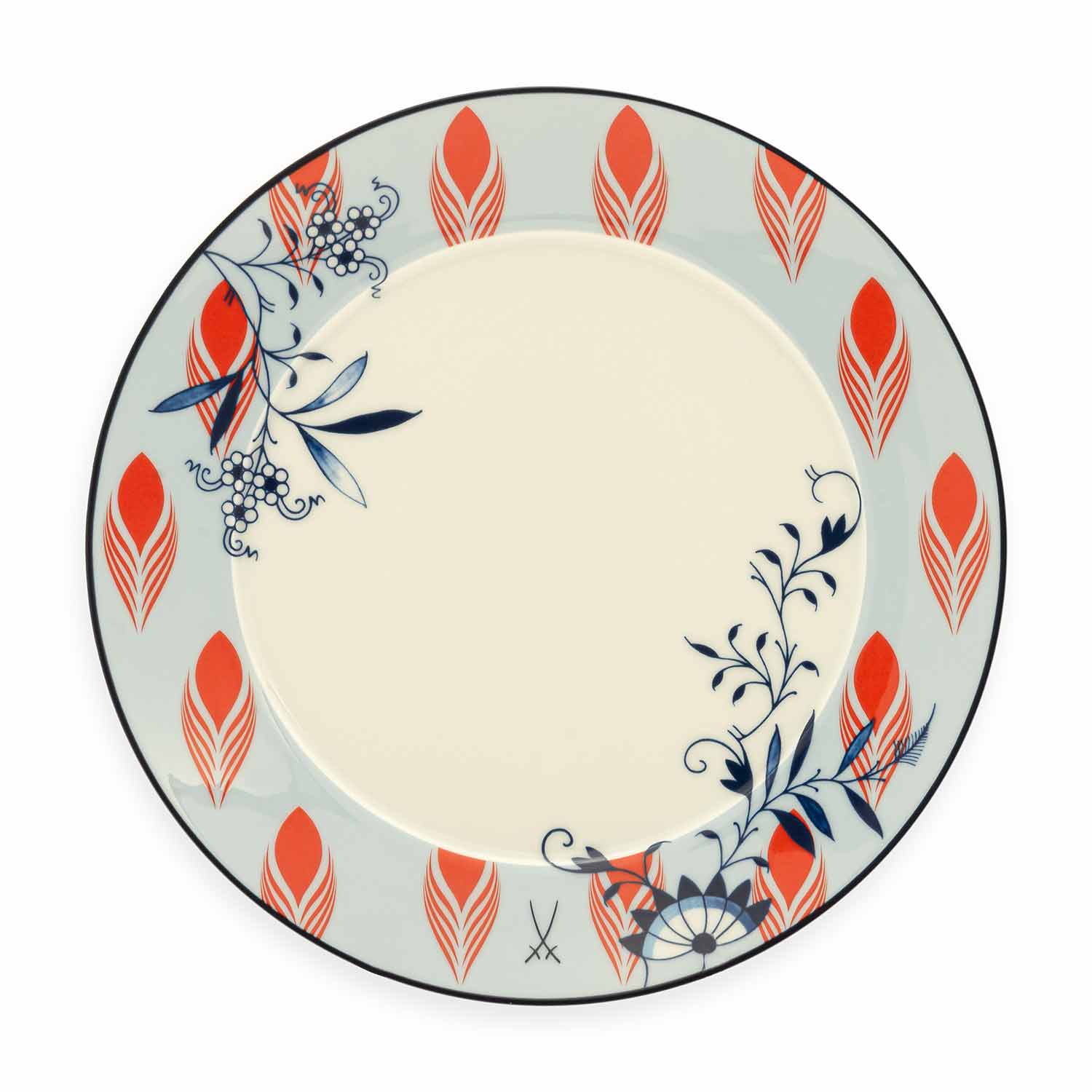
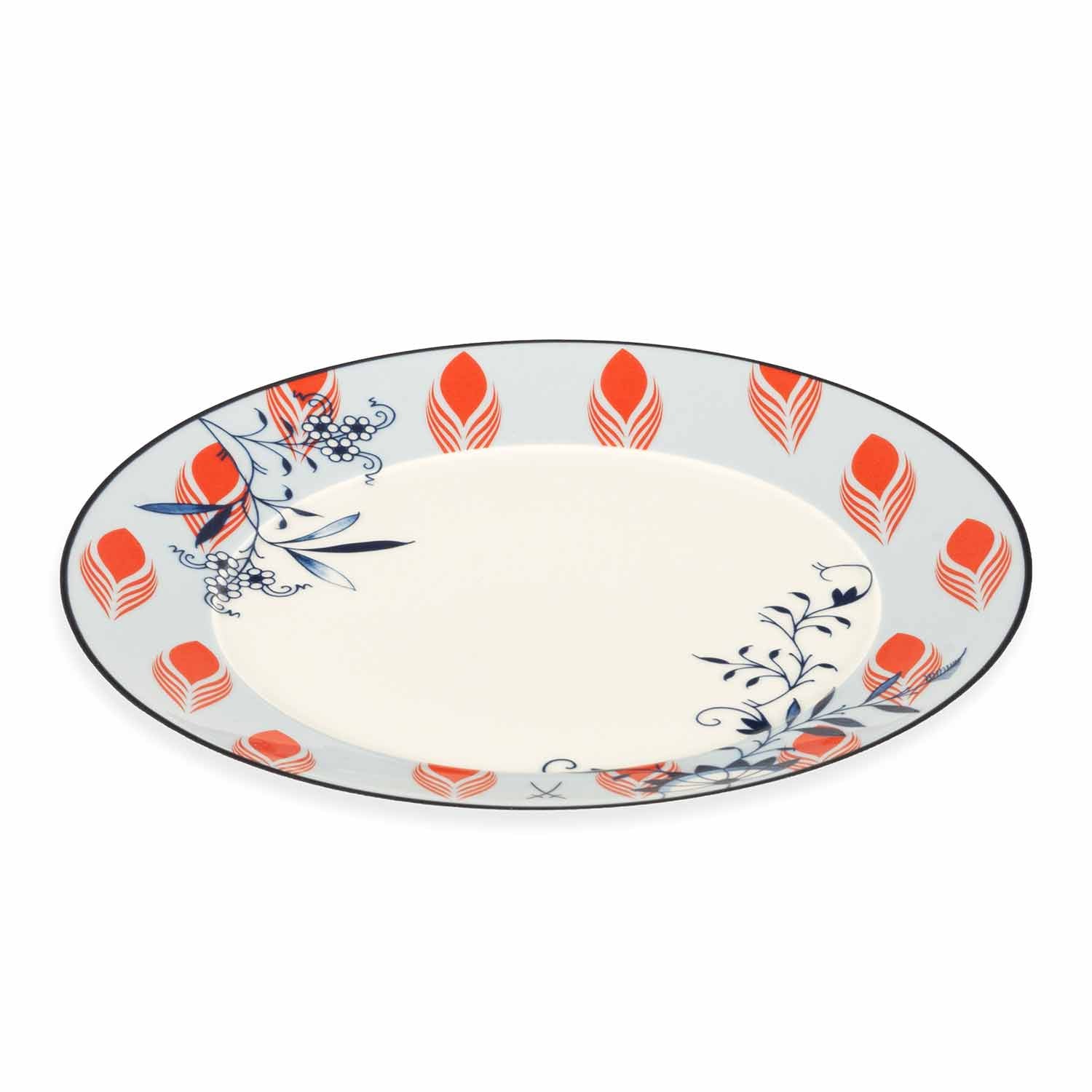
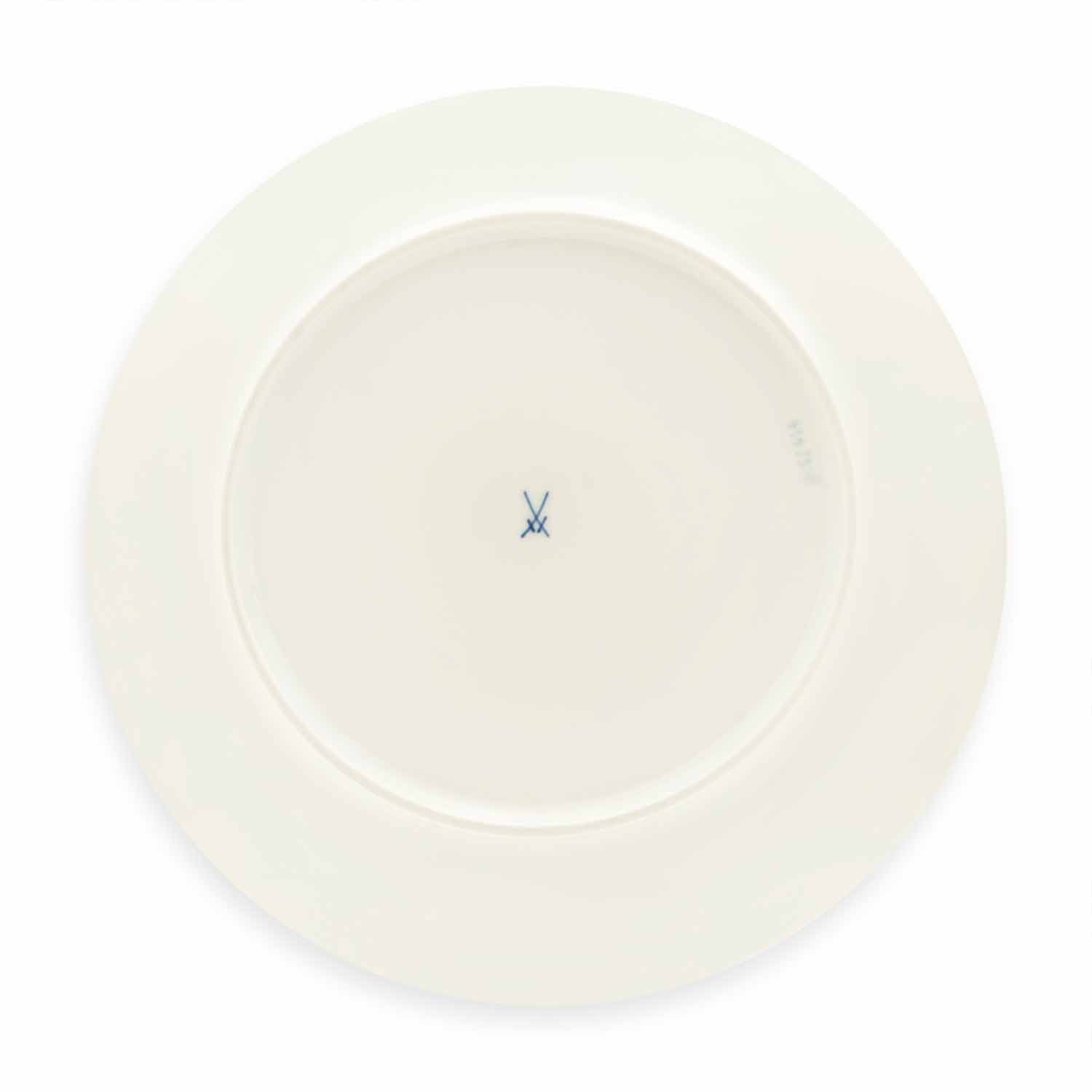
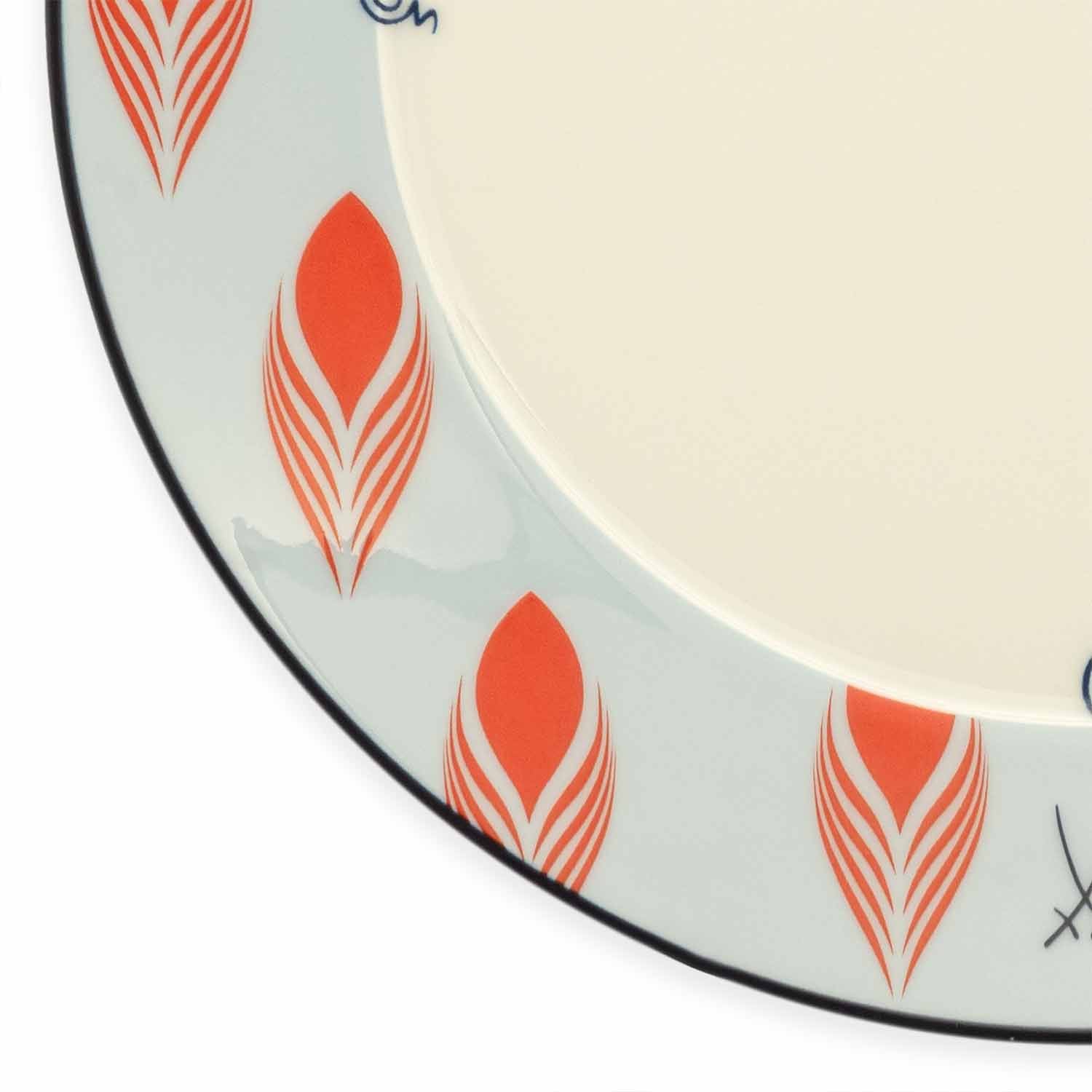
Bloomy Blue Feather Side Plate
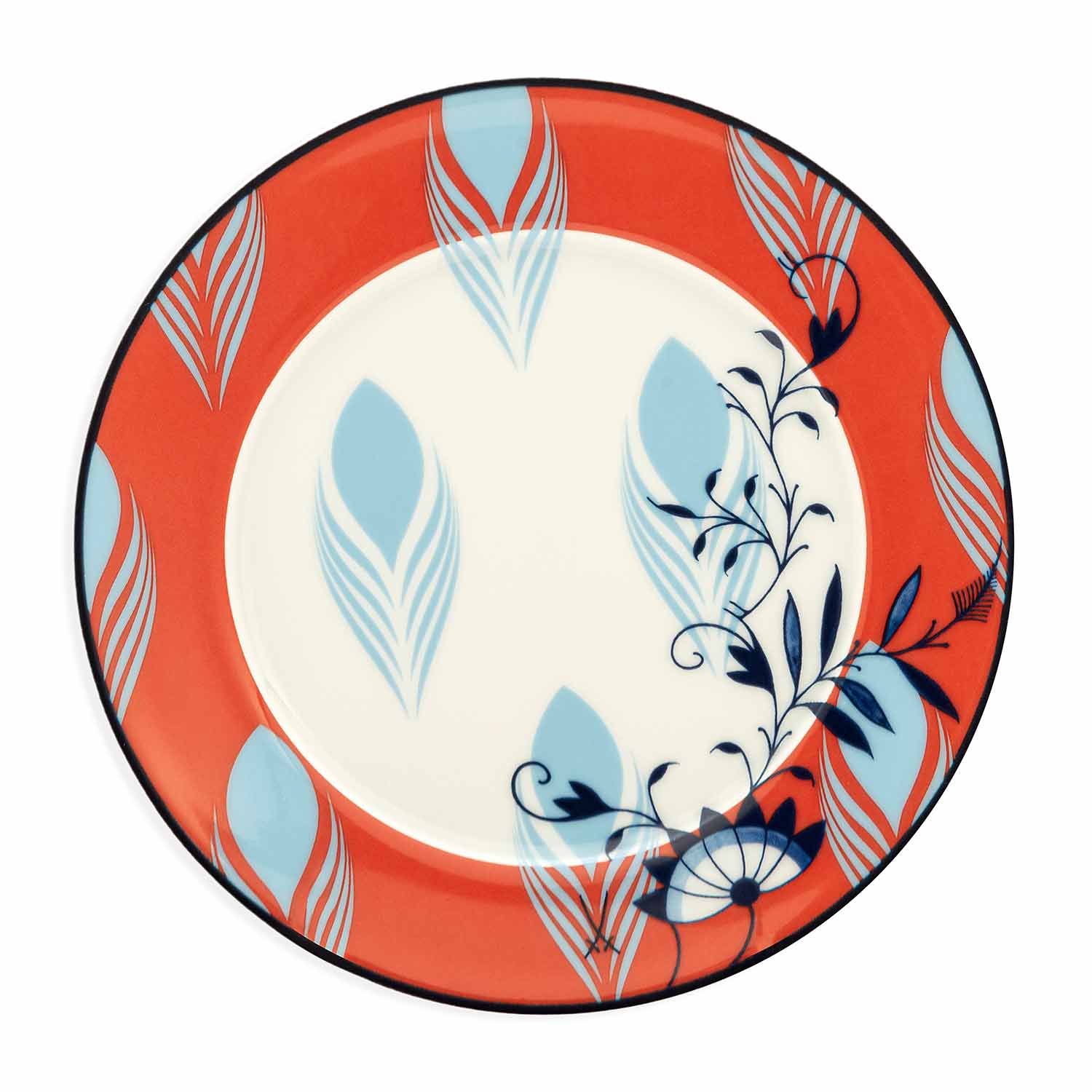
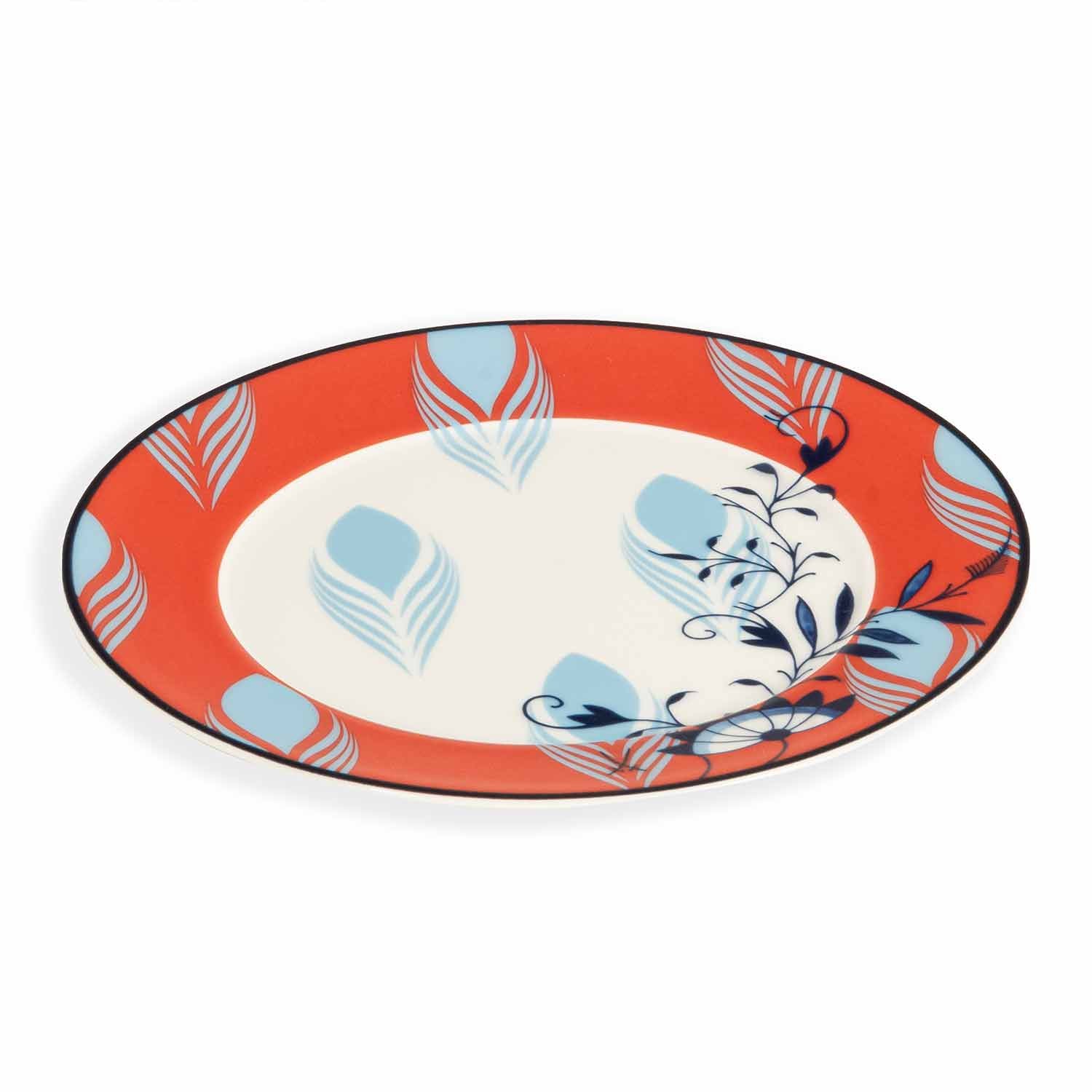
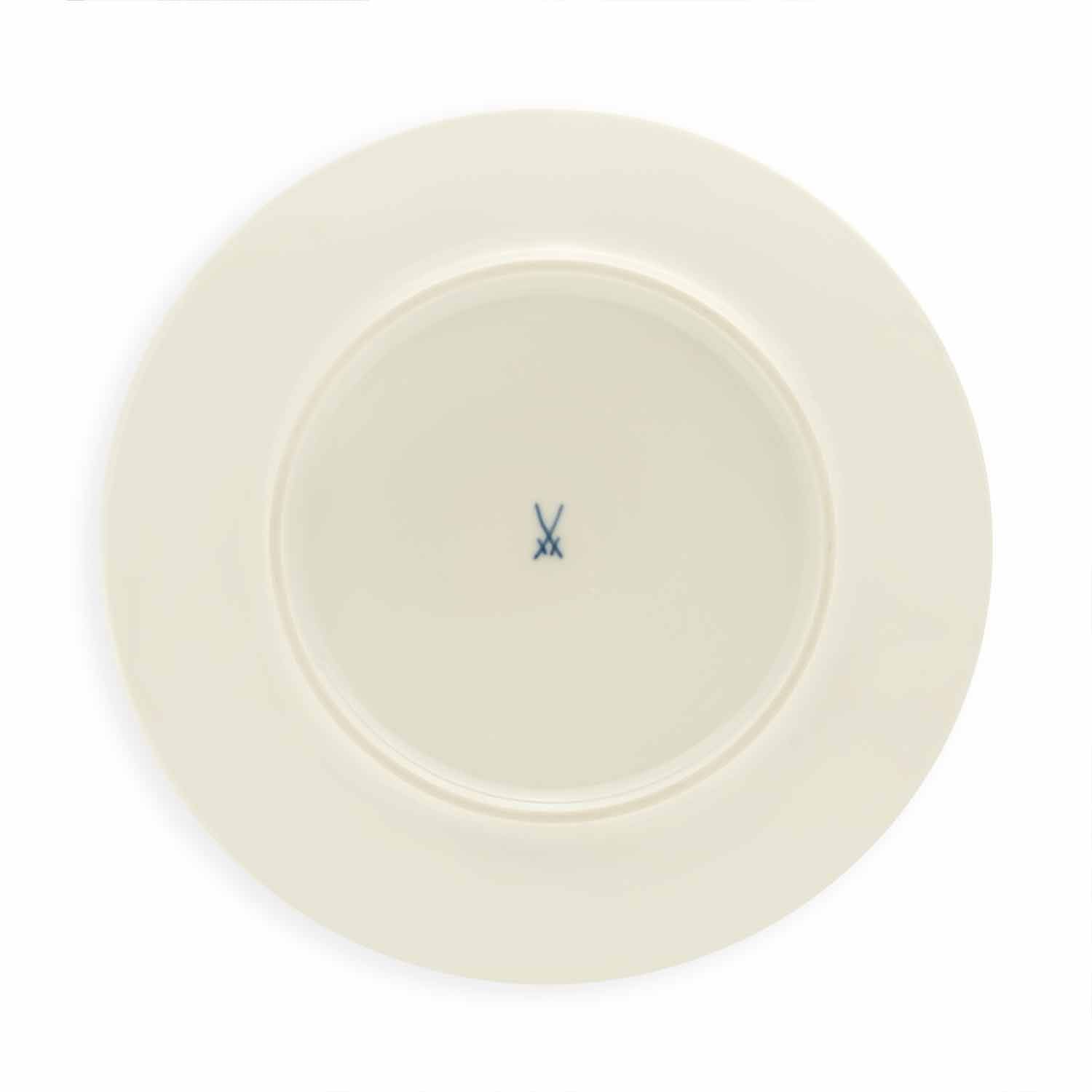
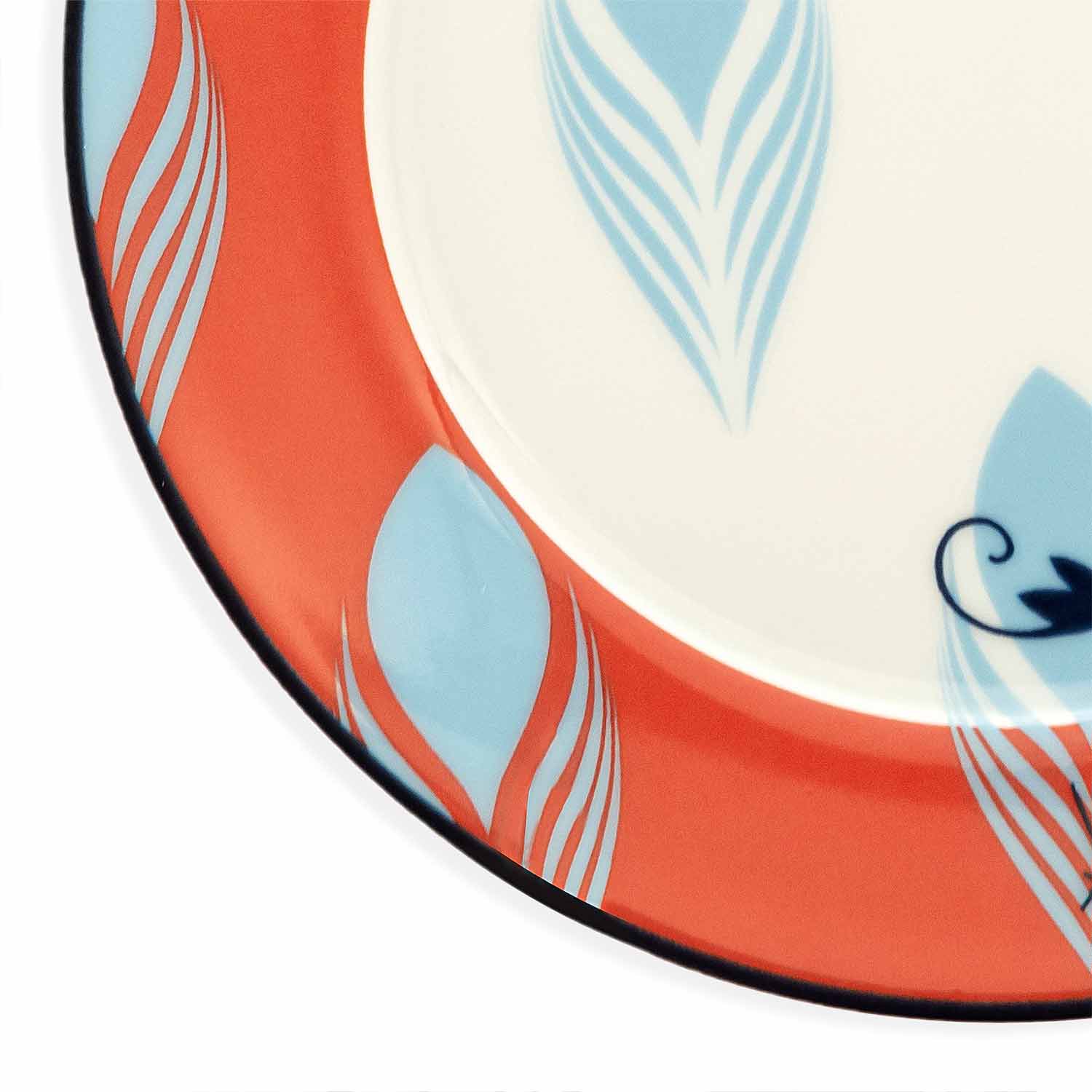
Bloomy Red Feather Bread and Butter Plate 17 cm
Meissen Porcelain | Europe's Oldest Porcelain Manufactory | Thomas Goode India
Meissen is the oldest porcelain manufactory in Europe, established in Saxony in 1710 under the patronage of Augustus the Strong, Elector of Saxony and King of Poland. Its founding represents one of the most consequential events in the history of European decorative art: for the first time, European craftsmen had succeeded in producing true hard-paste porcelain — the material that China and Japan had monopolised for centuries and that European courts had been importing at extraordinary expense since the 16th century.
The story of Meissen's founding begins in 1708, when Ehrenfried Walther von Tschirnhaus a Saxon scientist and natural philosopher and Johann Friedrich Böttger — an alchemist who had claimed to be able to produce gold and been placed under the patronage, and effectively the captivity, of Augustus the Strong — together achieved the breakthrough that had eluded every European experimenter before them: the production of a white, vitrified, translucent ceramic from kaolin clay fired at very high temperatures. The result was not gold, as Böttger had promised, but something Augustus ultimately considered more valuable: the first European hard-paste porcelain.
After von Tschirnhaus's death in October 1708, Böttger continued the work and brought the porcelain to production readiness. In 1710, Augustus the Strong founded the Royal Saxon Porcelain Manufactory at Albrechtsburg castle in the town of Meissen — choosing a fortified hilltop site specifically to protect the formula's secrecy from the competing courts of Europe who were desperately trying to replicate the achievement. For the first three decades of Meissen's existence, the manufactory held the sole European monopoly on the production of true hard-paste porcelain.
The significance of this founding moment for the history of European luxury tableware cannot be overstated. Every European porcelain house that followed — Herend in Hungary, Haviland in France, Hering Berlin in Germany — traces its material tradition, directly or indirectly, to the discovery made in Saxony in 1708 and brought to production at Meissen in 1710. Meissen is not merely the oldest European porcelain house, it is the origin point of the entire European fine porcelain tradition.
Thomas Goode India carries an authorised Meissen piece at The Oberoi Hotel, New Delhi and online — bringing one of the most historically significant objects in the European decorative arts tradition to the Indian luxury market.
The B-Form Royal Blue Gold Bronze Strewn Flowers Dinner Plate
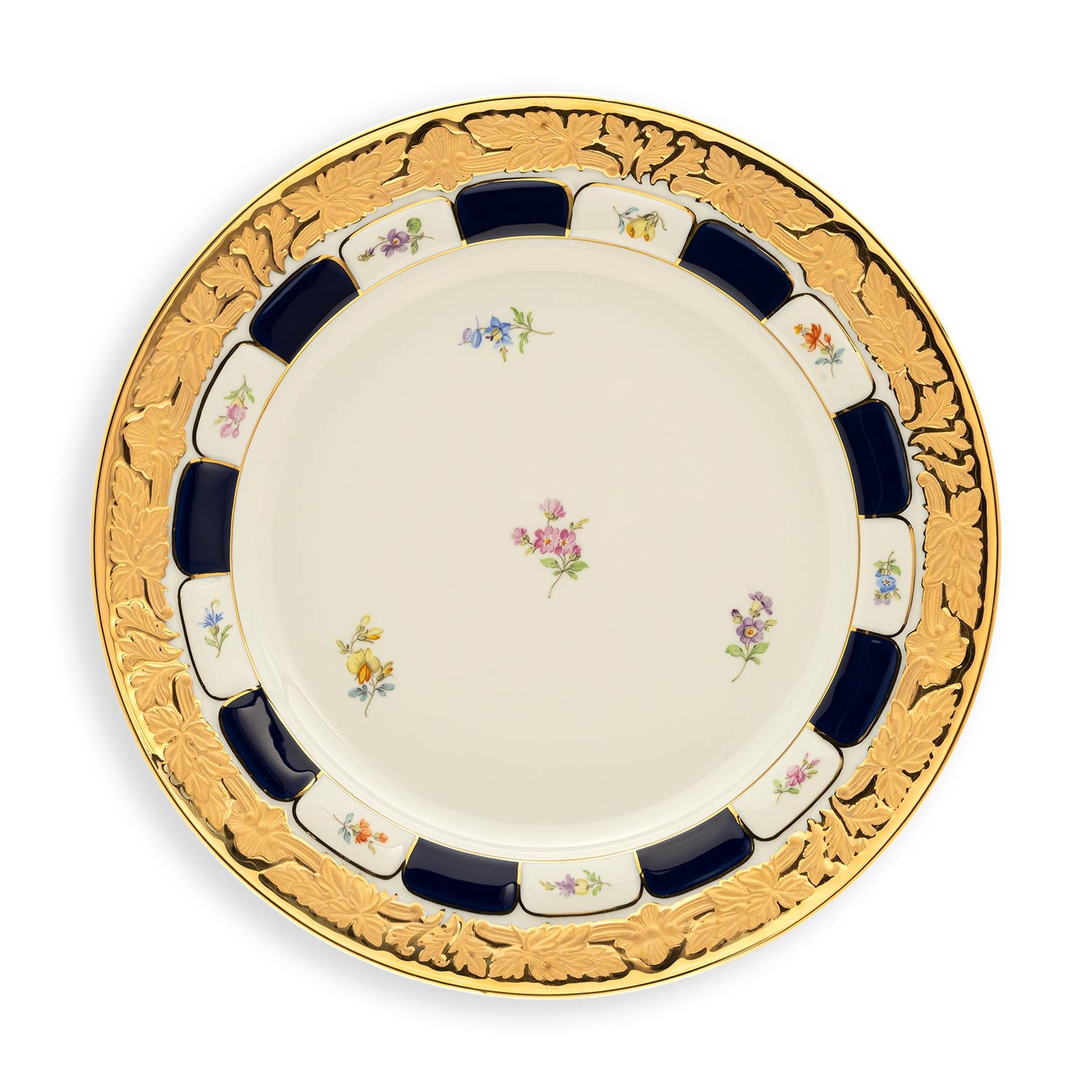
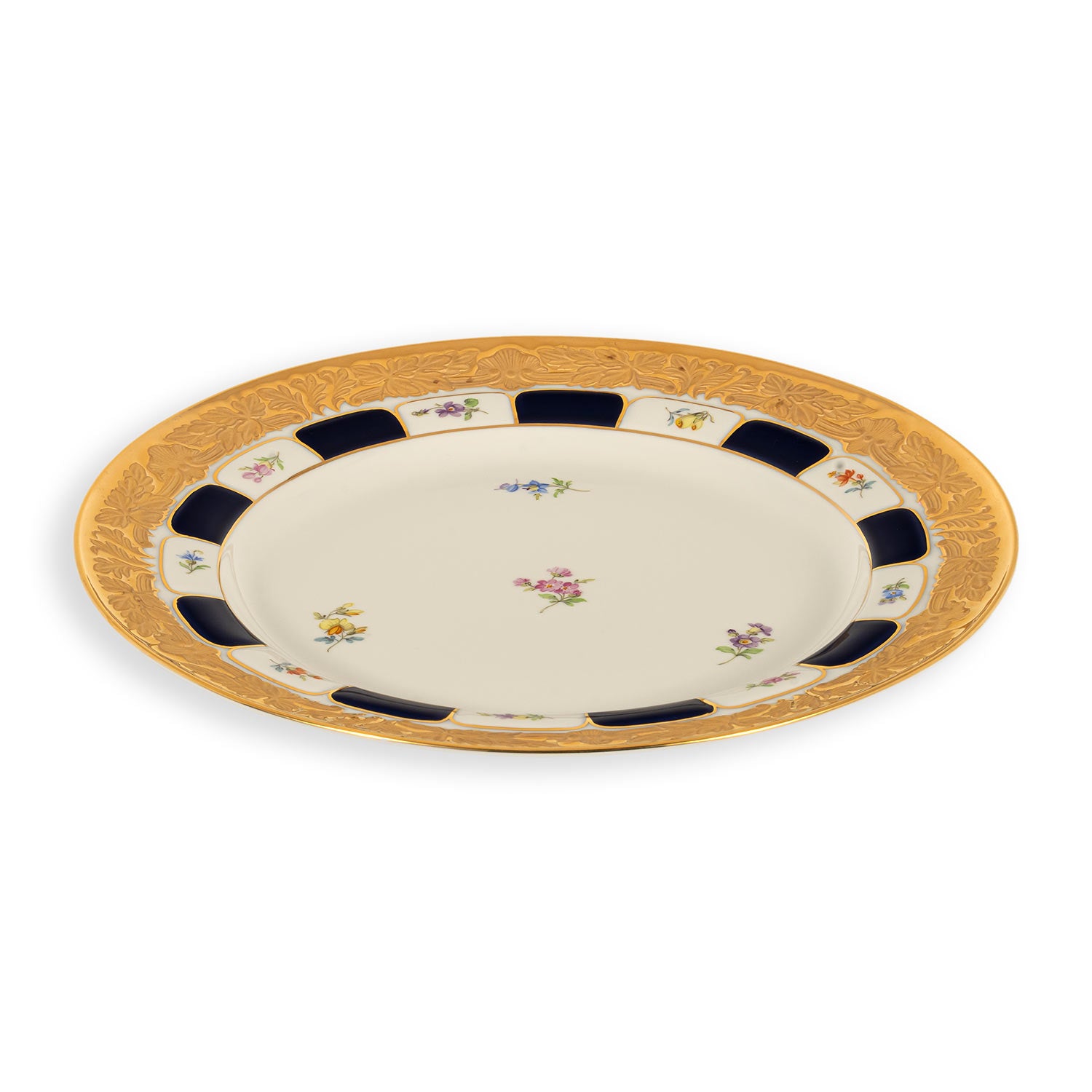
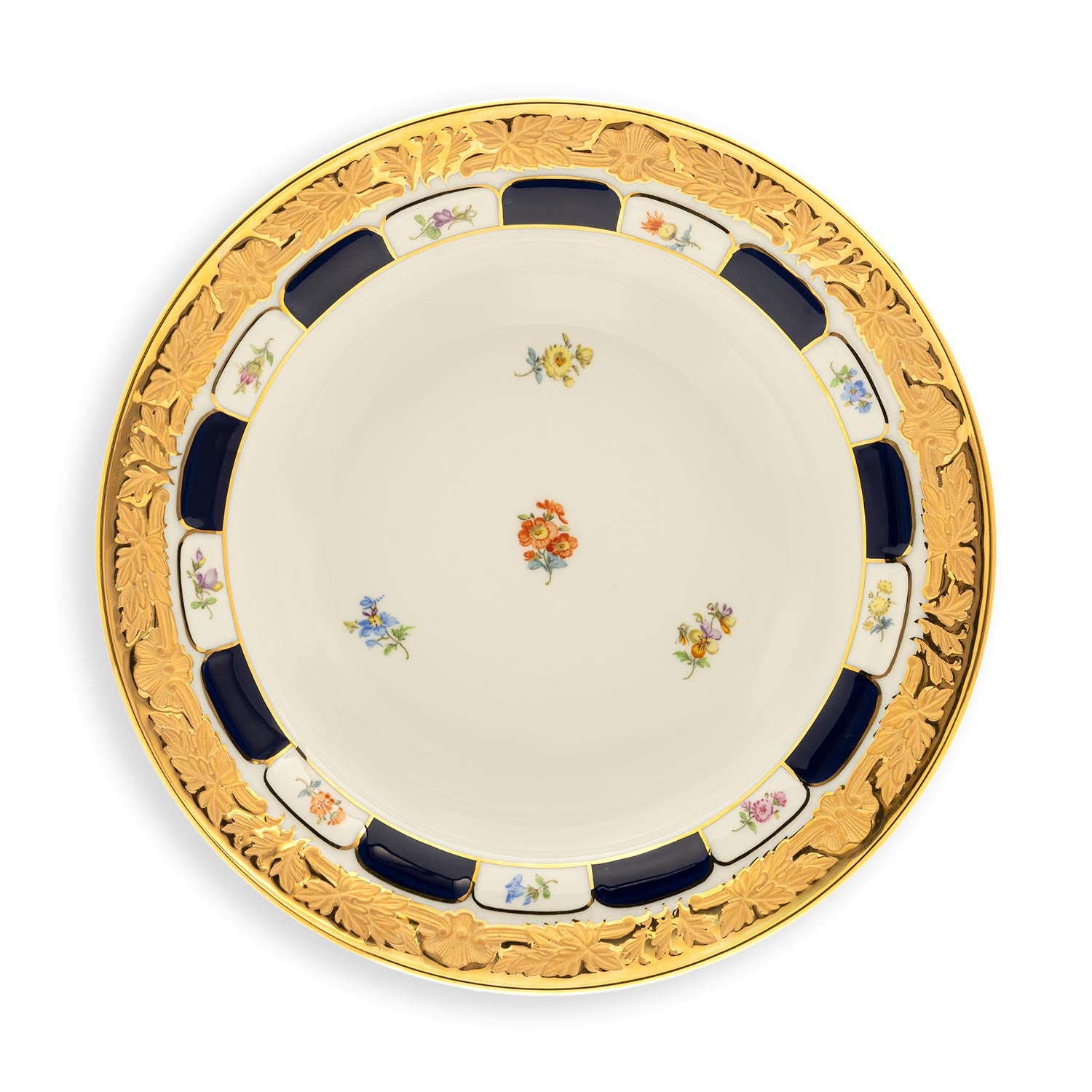
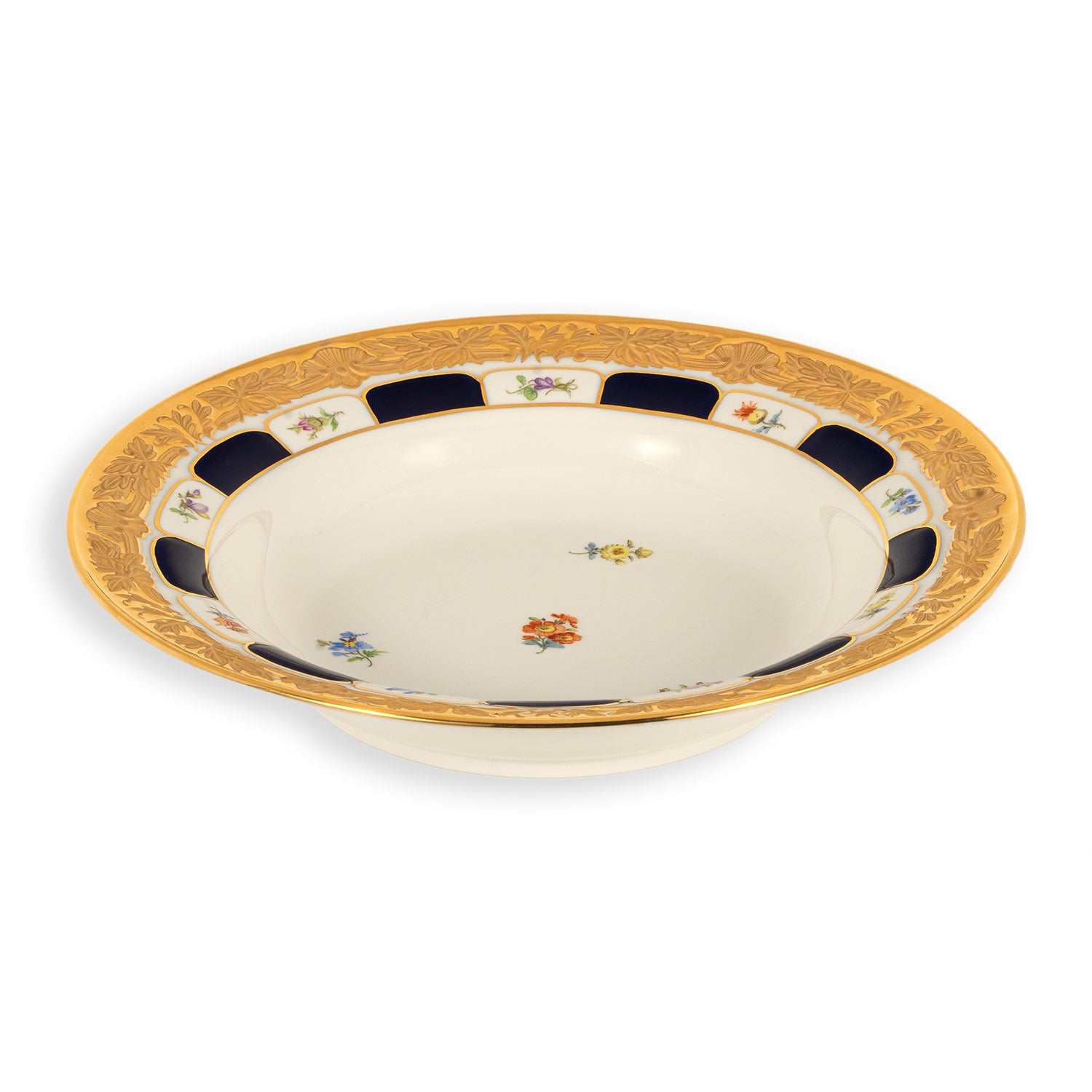
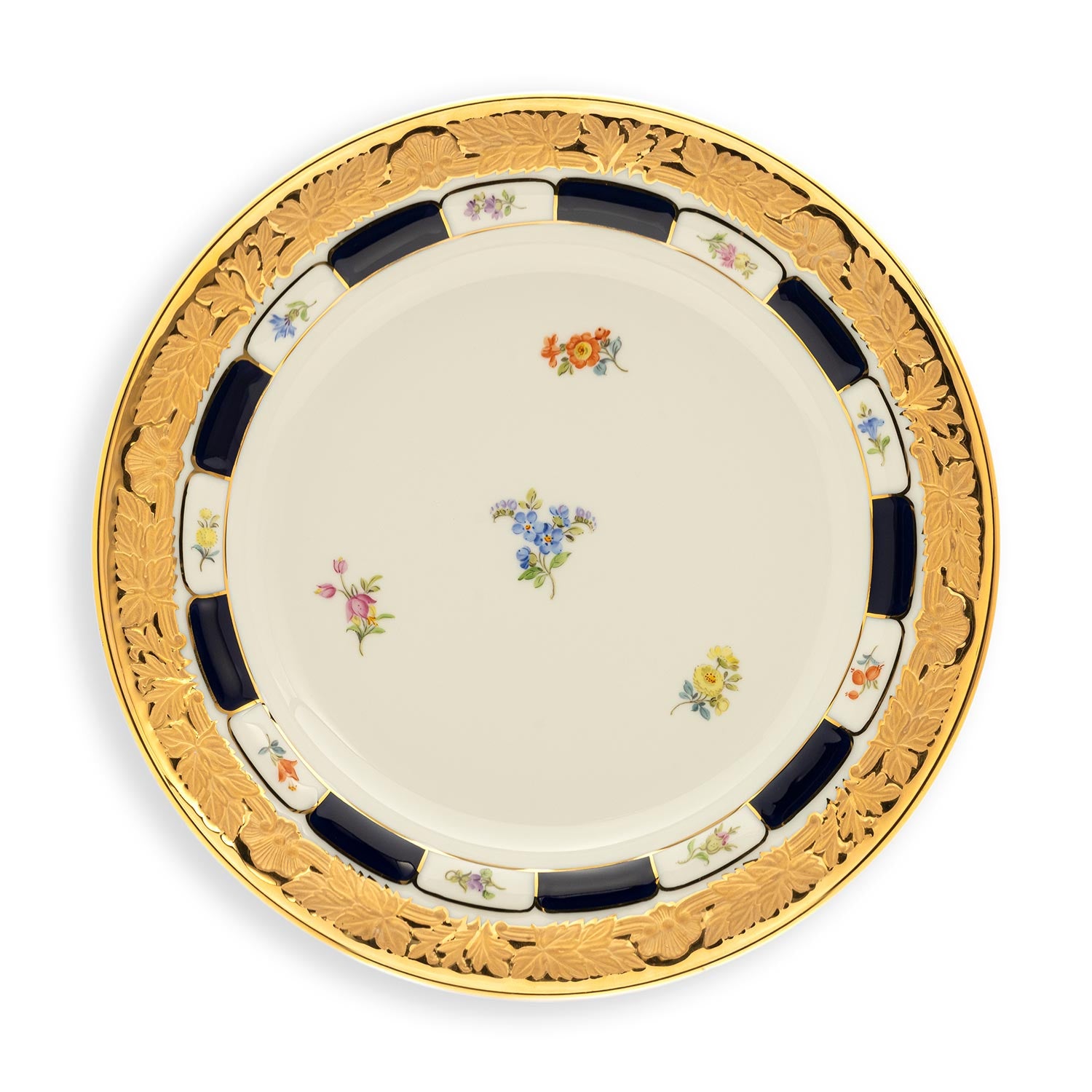
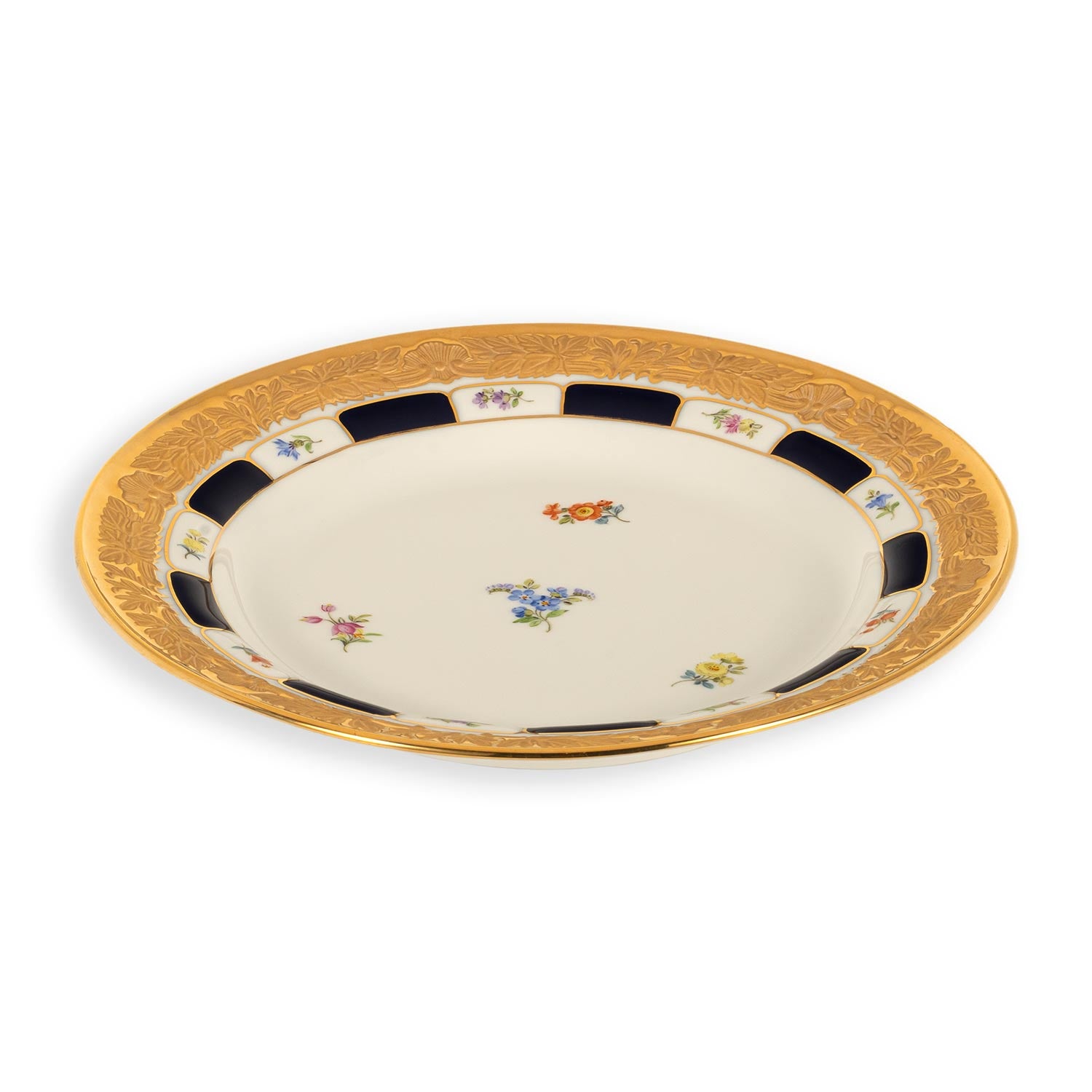
The single Meissen piece available at Thomas Goode India is the B-Form Royal Blue Gold Bronze Strewn Flowers Dinner Plate — a dinner plate that places the buyer within one of the most historically authoritative decorative traditions in the world.
The B-Form
The B-Form is one of Meissen's foundational plate shapes a classical plate proportion with a gently curved profile and a consistent rim width that has been in production at the Meissen manufactory for generations. The "B" designation in Meissen's naming system refers to this specific form family, and its continued production across three centuries is itself a statement of design authority: a form that has survived every change in taste and fashion since the 18th century because its proportions are, in the precise sense, correct.
Royal Blue Ground
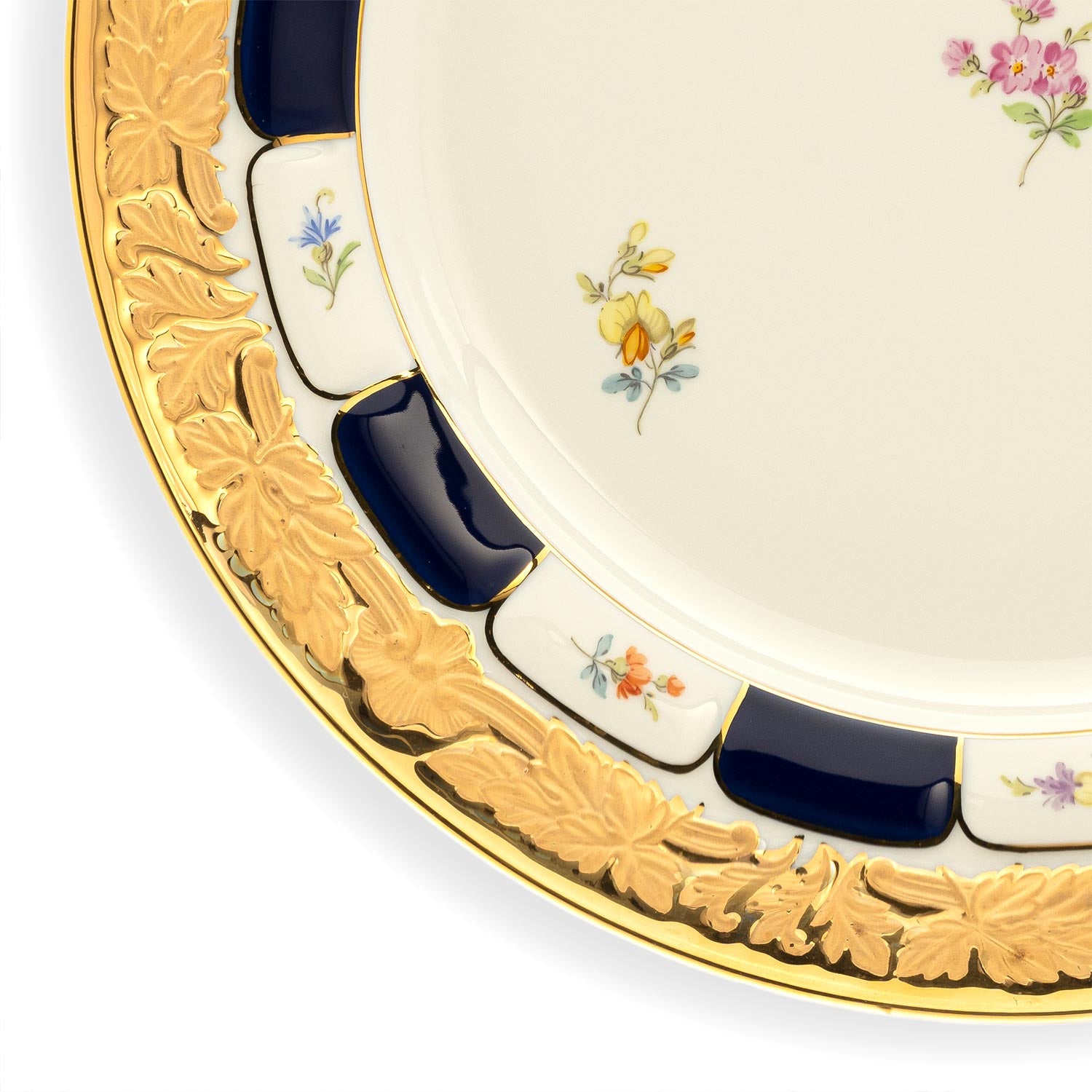
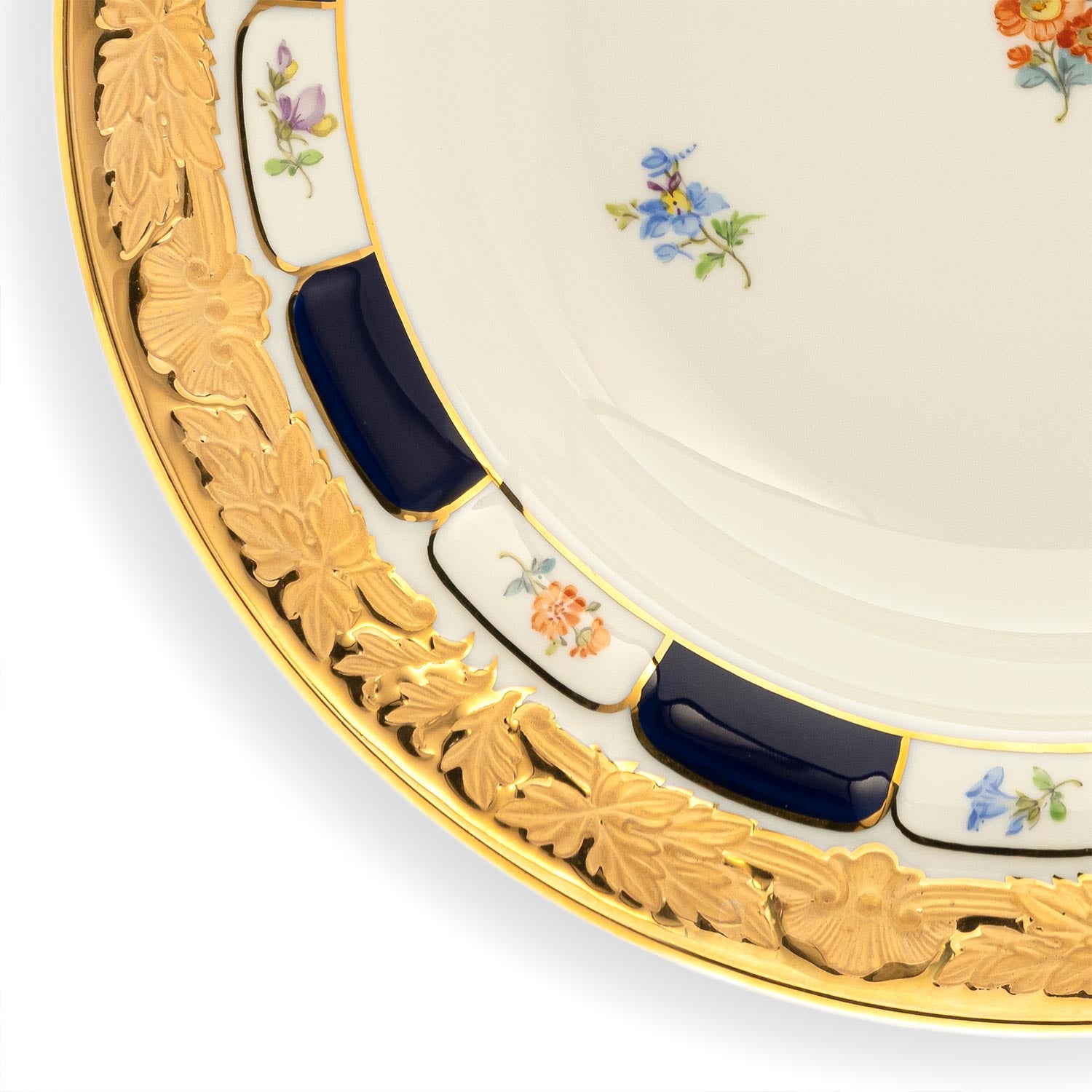
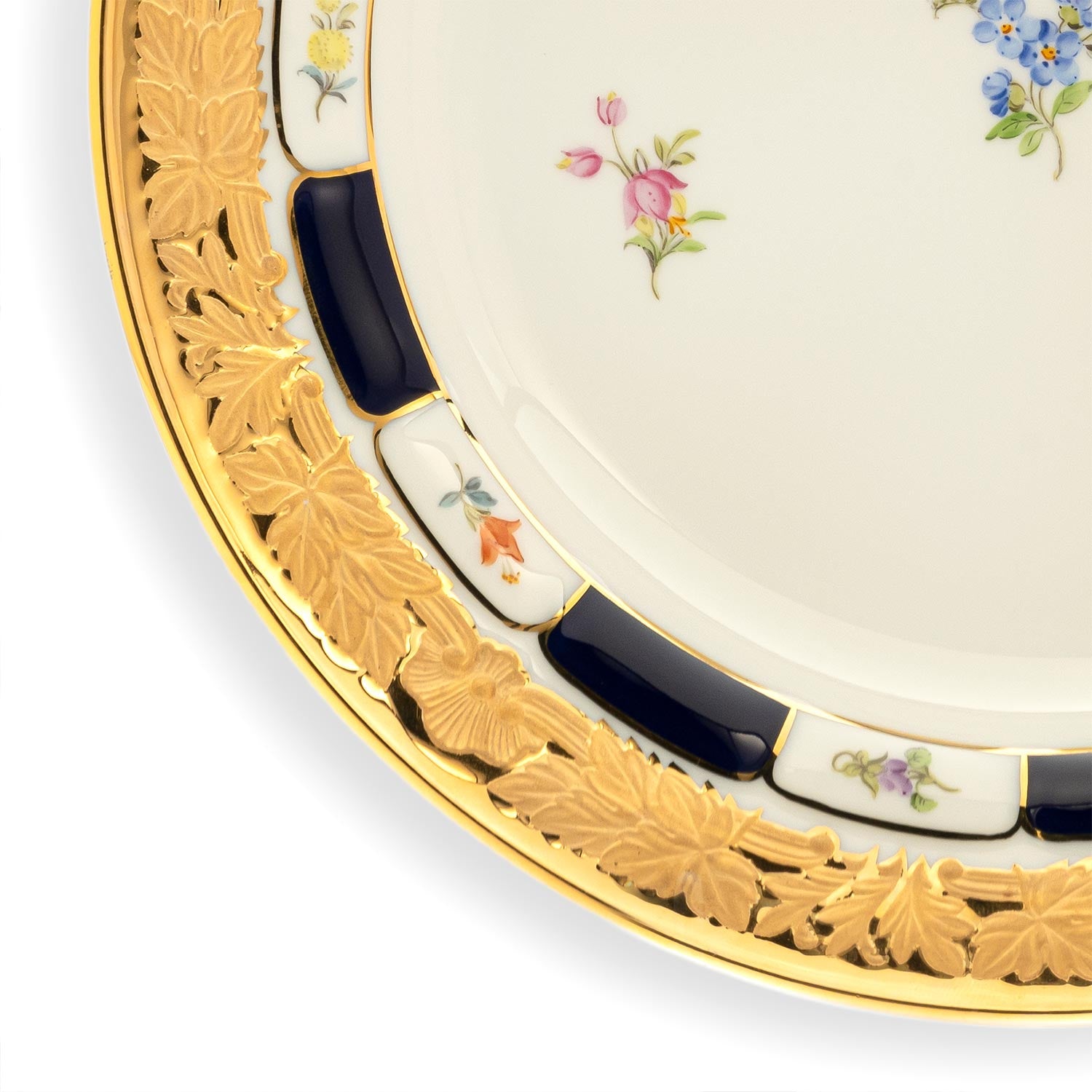
The Royal Blue ground of this plate is one of the most historically significant decorative elements in the European porcelain tradition. Meissen developed its blue ground colours including the deep cobalt-derived Royal Blue in the first decades of the manufactory's production, during the period when the artistic director Johann Gregor Höroldt was establishing the decorative vocabulary that would define European fine porcelain for generations. The Meissen blue, applied as an underglaze or ground colour, achieves a depth and richness that has been a defining quality of the manufactory's most formal pieces since the 1720s.
Gold and Bronze Strewn Flowers
The Strewn Flowers motif loose, scattered botanical sprays applied across the plate surface is among the earliest and most characteristic decorative elements in the Meissen vocabulary. The German term for this motif, Streublumen (strewn flowers), appears in Meissen production records from the 1720s onward. At their finest, Meissen Streublumen are individually painted flower heads, each a small-scale botanical study — rose, tulip, carnation, forget-me-not — applied by hand by trained porcelain painters who specialise in this specific decorative tradition. The gold and bronze metallic application in this colourway frames and accents the flower motifs with the warmth characteristic of Meissen's most formal pieces.
The Complete Design Statement
The B-Form Royal Blue Gold Bronze Strewn Flowers Dinner Plate is a design object that carries the full weight of Meissen's history in a format suited to active use. It is a dinner plate — the primary piece at the formal table — in a combination of ground colour, motif, and metallic accent that references the most distinguished strand of the Meissen decorative tradition continuously from the 1720s to the present. Placing this plate on a formal table is placing over three centuries of European porcelain history at each cover.
Meissen and the European Porcelain Tradition
The Arcanum and the Monopoly
The formula for hard-paste porcelain was, in the 18th century, one of the most commercially valuable trade secrets in Europe. The workers at Meissen who knew the formula — the arcanum — were effectively prisoners of the state, forbidden from leaving Saxony and required to take oaths of secrecy on pain of severe punishment. Despite these measures, the formula eventually leaked, and by the mid-18th century other European courts had established their own porcelain manufactories: Vienna (1718), Doccia (1737), Capodimonte (1743), Sèvres (1756).
The competitive European porcelain landscape that emerged from this period produced the decorative traditions that Thomas Goode India's collection inherits across all its major makers. Meissen was the origin, but the spread of the arcanum created the wider European luxury porcelain world.
The Crossed Swords Mark
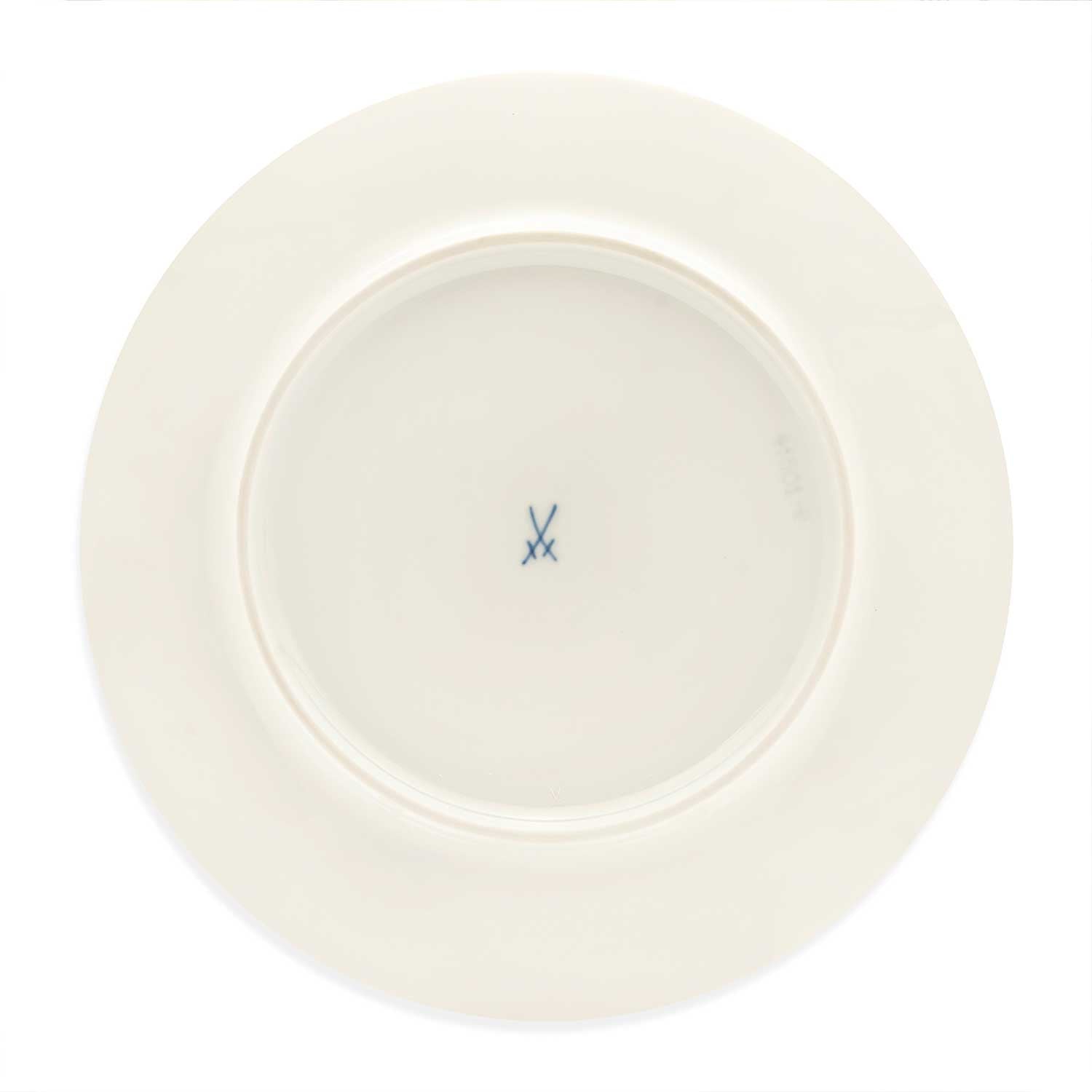
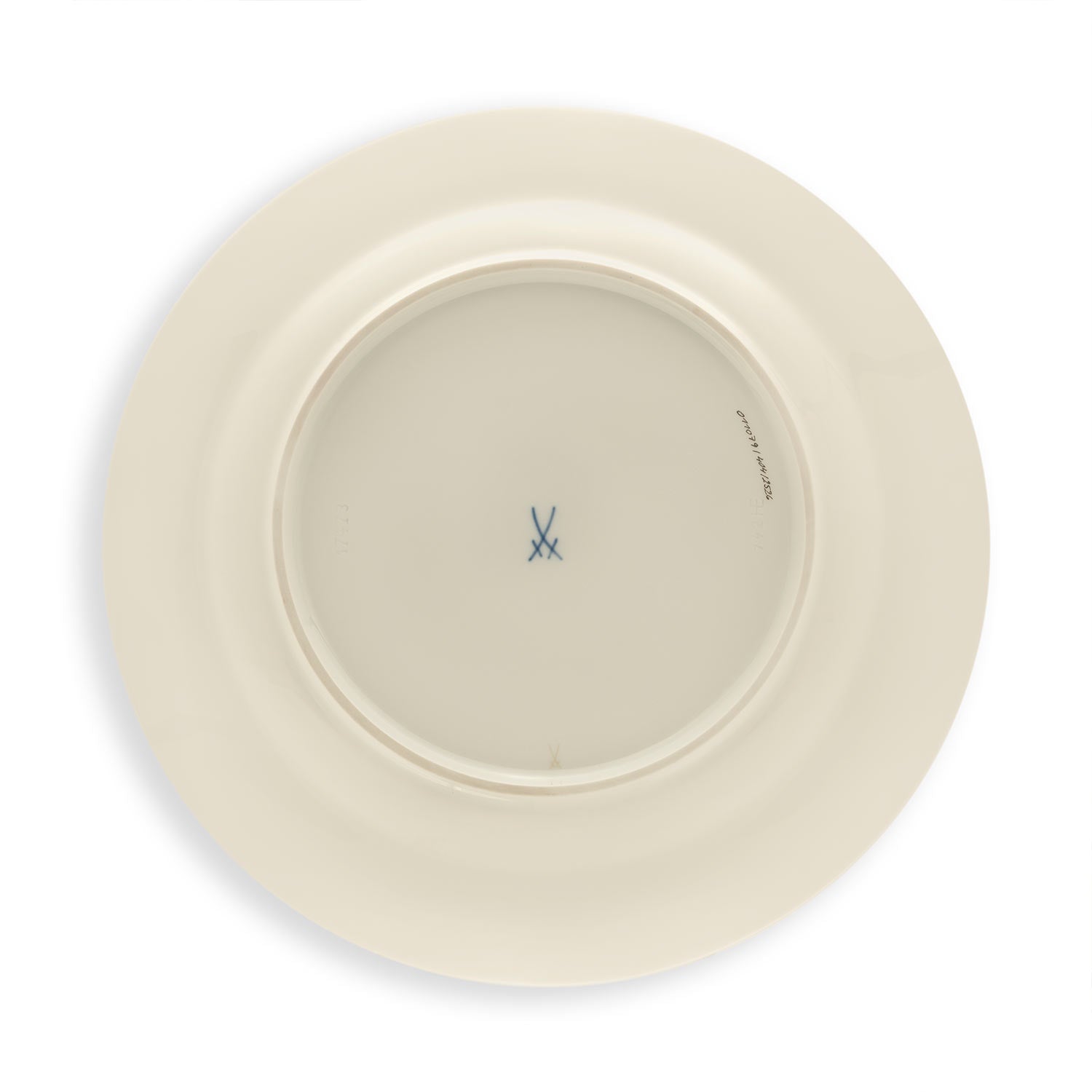
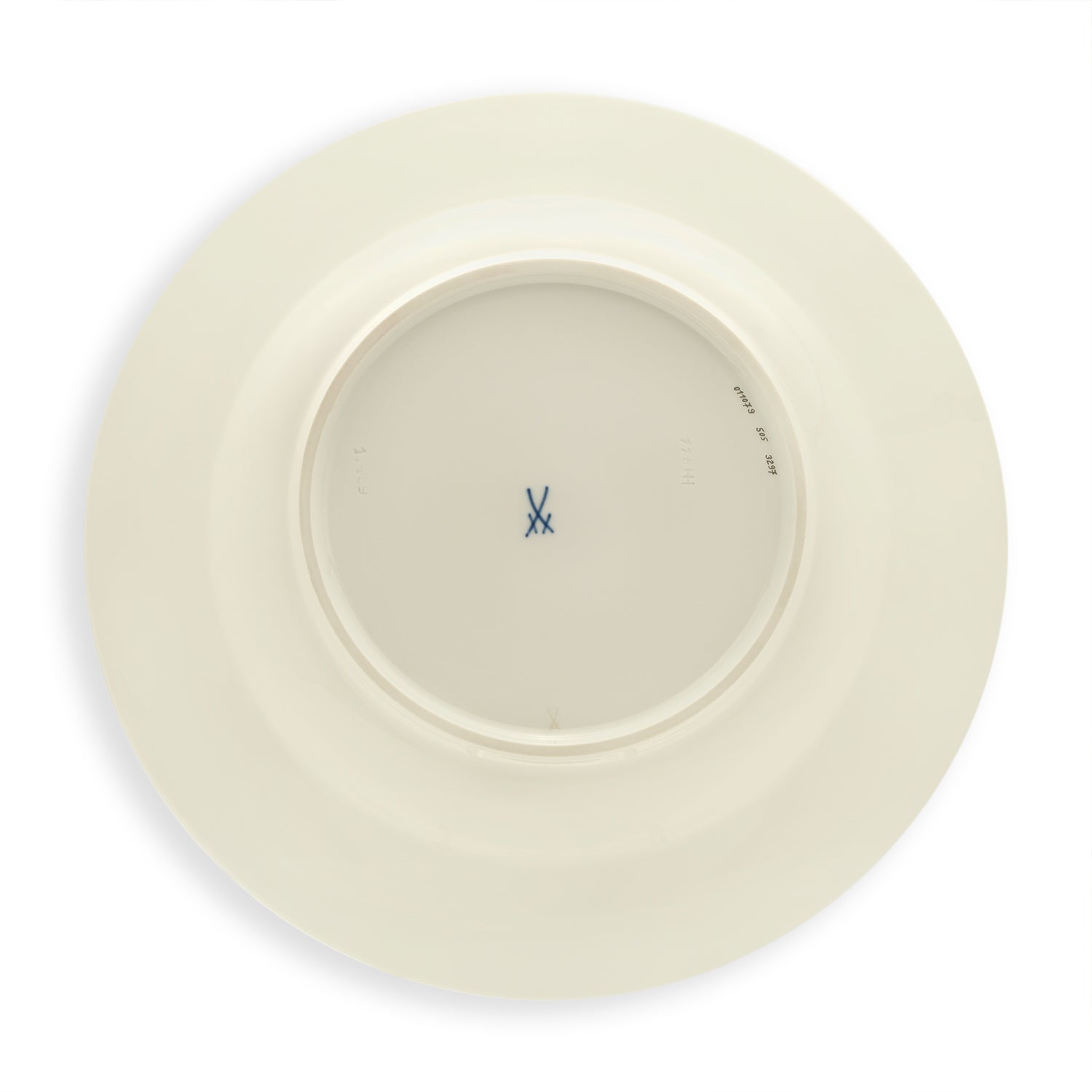
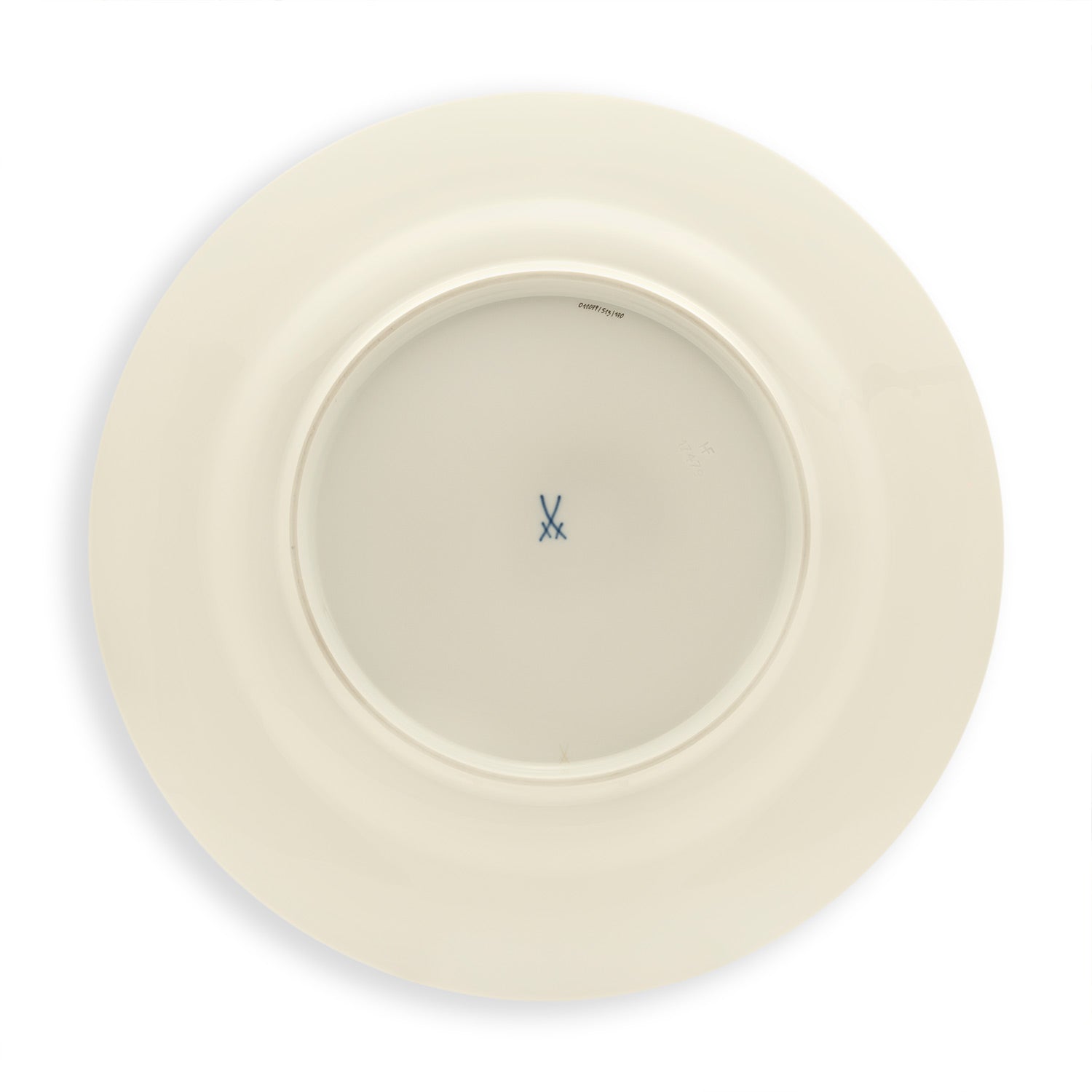
Every piece of genuine Meissen porcelain carries the crossed swords mark on its base — a mark introduced in the early 18th century and one of the oldest and most recognised quality marks in the history of decorative art. The crossed swords are the heraldic symbol of Saxony, applied to Meissen's production from the earliest period and maintained continuously as the manufactory's mark of authenticity ever since. A Meissen piece with the crossed swords is a documented object with over three centuries of production heritage behind it.
Meissen's Artistic Legacy
Beyond tableware, Meissen's contribution to European decorative art extends into figurines, sculptural objects, and architectural ceramics. The Meissen figurine tradition — established by the sculptor Johann Joachim Kändler from the 1730s onward — produced some of the finest small-scale ceramic sculpture in the Western tradition. Meissen figures of the 18th century are now held in the major decorative arts museums worldwide and command significant prices at auction. The decorative painting tradition established by Johann Gregor Höroldt — chinoiserie scenes, European landscapes, botanical studies, the Strewn Flowers that appear on the Thomas Goode India plate — set the standard for European porcelain decoration that remained dominant for the rest of the 18th century.
Meissen at Thomas Goode India
Within the Thomas Goode India collection, Meissen occupies the position of maximum historical authority. It is the oldest European porcelain house — older than Herend (1826), Haviland (1842), Christofle (1830), Thomas Goode itself (1827), and Saint-Louis (1586) only in the crystal category — and as the literal origin of the European hard-paste porcelain tradition, it carries a provenance that no other maker in any category can match.
The B-Form Royal Blue Gold Bronze Strewn Flowers Dinner Plate is available in the Dinnerware collection at Thomas Goode India. For the collector or buyer whose table is assembled with the full awareness of each piece's place in decorative history, a Meissen plate is the most authoritative single acquisition available.
To Shop Meissen Luxury Porcelain Online in India, the collection is available at thomasgoode.in/collections/meissen, with personalised assistance from the Thomas Goode India team.
Frequently Asked Questions
What is Meissen porcelain and when was it founded?
Meissen is the oldest porcelain manufactory in Europe, established in 1710 at Albrechtsburg castle in Meissen, Saxony, by Augustus the Strong, Elector of Saxony and King of Poland. Its founding followed the work of Ehrenfried Walther von Tschirnhaus and Johann Friedrich Böttger, who achieved the first successful production of European hard-paste porcelain in 1708 — ending the monopoly on porcelain production that China and Japan had held for centuries. Meissen held the sole European monopoly on hard-paste porcelain for its first three decades. Available at Thomas Goode India, The Oberoi Hotel, New Delhi.
What makes Meissen the most historically significant porcelain house in Europe?
Meissen is the origin point of the entire European fine porcelain tradition. Before 1708, European craftsmen had been unable to produce true hard-paste porcelain — the vitrified, translucent ceramic that China and Japan had produced for centuries. Every European porcelain house that followed — Herend, Haviland, Sèvres, Vienna, and all others — traces its material tradition to the discovery made in Saxony in 1708 and brought to production at Meissen in 1710. The Meissen crossed swords mark, introduced in the early 18th century, is one of the oldest quality marks in the history of decorative art.
What is the B-Form at Meissen?
The B-Form is one of Meissen's foundational plate shapes — a classical proportion with a gently curved profile and consistent rim width that has been in continuous production at the manufactory for generations. The "B" designation refers to this specific form family in Meissen's naming system. The B-Form's survival across three centuries of production is itself a statement of design authority: a proportion that has remained correct across every change in taste since the 18th century.
What is the Strewn Flowers or Streublumen motif on the Meissen dinner plate?
The Strewn Flowers motif — Streublumen in German — is a decorative element that appears in Meissen production records from the 1720s onward: loose, scattered botanical sprays of individually painted flower heads including rose, tulip, carnation, and forget-me-not, applied by hand by trained porcelain painters. On the B-Form Royal Blue Gold Bronze Strewn Flowers Dinner Plate at Thomas Goode India, the gold and bronze metallic application frames and accents the scattered flower motifs with the warmth characteristic of Meissen's most formal pieces.
What is the Meissen crossed swords mark?
The crossed swords mark is the heraldic symbol of Saxony, applied to the base of every genuine Meissen piece from the early 18th century to the present day. It is one of the oldest continuously used quality marks in the history of decorative art. A Meissen piece with the crossed swords is a documented object with over three centuries of production heritage. The crossed swords mark was introduced specifically to distinguish genuine Meissen from imitations, which were common from the earliest period of the manufactory's existence.
How does Meissen differ from other European fine porcelain houses at Thomas Goode India?
Meissen (founded 1710) is the oldest European porcelain house and the origin of the European hard-paste porcelain tradition. Herend (1826) represents the Central European court hand-painting tradition at its most accomplished. Haviland (1842) represents the French Limoges tradition, with its American-French founding story and White House presidential commissions. Hering Berlin (1992) represents contemporary German fine porcelain with its bisque-and-glaze innovation. Meissen's distinction is its founding position — the literal origin of the tradition from which all others derive.
Meissen Porcelain | Europe's Oldest Porcelain Manufactory | Thomas Goode India
Meissen is the oldest porcelain manufactory in Europe, established in Saxony in 1710 under the patronage of Augustus the Strong, Elector of Saxony and King of Poland. Its founding represents one of the most consequential events in the history of European decorative art: for the first time, European craftsmen had succeeded in producing true hard-paste porcelain — the material that China and Japan had monopolised for centuries and that European courts had been importing at extraordinary expense since the 16th century.
The story of Meissen's founding begins in 1708, when Ehrenfried Walther von Tschirnhaus a Saxon scientist and natural philosopher and Johann Friedrich Böttger — an alchemist who had claimed to be able to produce gold and been placed under the patronage, and effectively the captivity, of Augustus the Strong — together achieved the breakthrough that had eluded every European experimenter before them: the production of a white, vitrified, translucent ceramic from kaolin clay fired at very high temperatures. The result was not gold, as Böttger had promised, but something Augustus ultimately considered more valuable: the first European hard-paste porcelain.
After von Tschirnhaus's death in October 1708, Böttger continued the work and brought the porcelain to production readiness. In 1710, Augustus the Strong founded the Royal Saxon Porcelain Manufactory at Albrechtsburg castle in the town of Meissen — choosing a fortified hilltop site specifically to protect the formula's secrecy from the competing courts of Europe who were desperately trying to replicate the achievement. For the first three decades of Meissen's existence, the manufactory held the sole European monopoly on the production of true hard-paste porcelain.
The significance of this founding moment for the history of European luxury tableware cannot be overstated. Every European porcelain house that followed — Herend in Hungary, Haviland in France, Hering Berlin in Germany — traces its material tradition, directly or indirectly, to the discovery made in Saxony in 1708 and brought to production at Meissen in 1710. Meissen is not merely the oldest European porcelain house, it is the origin point of the entire European fine porcelain tradition.
Thomas Goode India carries an authorised Meissen piece at The Oberoi Hotel, New Delhi and online — bringing one of the most historically significant objects in the European decorative arts tradition to the Indian luxury market.
The B-Form Royal Blue Gold Bronze Strewn Flowers Dinner Plate
The single Meissen piece available at Thomas Goode India is the B-Form Royal Blue Gold Bronze Strewn Flowers Dinner Plate — a dinner plate that places the buyer within one of the most historically authoritative decorative traditions in the world.
The B-Form
The B-Form is one of Meissen's foundational plate shapes a classical plate proportion with a gently curved profile and a consistent rim width that has been in production at the Meissen manufactory for generations. The "B" designation in Meissen's naming system refers to this specific form family, and its continued production across three centuries is itself a statement of design authority: a form that has survived every change in taste and fashion since the 18th century because its proportions are, in the precise sense, correct.
Royal Blue Ground
The Royal Blue ground of this plate is one of the most historically significant decorative elements in the European porcelain tradition. Meissen developed its blue ground colours including the deep cobalt-derived Royal Blue in the first decades of the manufactory's production, during the period when the artistic director Johann Gregor Höroldt was establishing the decorative vocabulary that would define European fine porcelain for generations. The Meissen blue, applied as an underglaze or ground colour, achieves a depth and richness that has been a defining quality of the manufactory's most formal pieces since the 1720s.
Gold and Bronze Strewn Flowers
The Strewn Flowers motif loose, scattered botanical sprays applied across the plate surface is among the earliest and most characteristic decorative elements in the Meissen vocabulary. The German term for this motif, Streublumen (strewn flowers), appears in Meissen production records from the 1720s onward. At their finest, Meissen Streublumen are individually painted flower heads, each a small-scale botanical study — rose, tulip, carnation, forget-me-not — applied by hand by trained porcelain painters who specialise in this specific decorative tradition. The gold and bronze metallic application in this colourway frames and accents the flower motifs with the warmth characteristic of Meissen's most formal pieces.
The Complete Design Statement
The B-Form Royal Blue Gold Bronze Strewn Flowers Dinner Plate is a design object that carries the full weight of Meissen's history in a format suited to active use. It is a dinner plate — the primary piece at the formal table — in a combination of ground colour, motif, and metallic accent that references the most distinguished strand of the Meissen decorative tradition continuously from the 1720s to the present. Placing this plate on a formal table is placing over three centuries of European porcelain history at each cover.
Meissen and the European Porcelain Tradition
The Arcanum and the Monopoly
The formula for hard-paste porcelain was, in the 18th century, one of the most commercially valuable trade secrets in Europe. The workers at Meissen who knew the formula — the arcanum — were effectively prisoners of the state, forbidden from leaving Saxony and required to take oaths of secrecy on pain of severe punishment. Despite these measures, the formula eventually leaked, and by the mid-18th century other European courts had established their own porcelain manufactories: Vienna (1718), Doccia (1737), Capodimonte (1743), Sèvres (1756).
The competitive European porcelain landscape that emerged from this period produced the decorative traditions that Thomas Goode India's collection inherits across all its major makers. Meissen was the origin, but the spread of the arcanum created the wider European luxury porcelain world.
The Crossed Swords Mark
Every piece of genuine Meissen porcelain carries the crossed swords mark on its base — a mark introduced in the early 18th century and one of the oldest and most recognised quality marks in the history of decorative art. The crossed swords are the heraldic symbol of Saxony, applied to Meissen's production from the earliest period and maintained continuously as the manufactory's mark of authenticity ever since. A Meissen piece with the crossed swords is a documented object with over three centuries of production heritage behind it.
Meissen's Artistic Legacy
Beyond tableware, Meissen's contribution to European decorative art extends into figurines, sculptural objects, and architectural ceramics. The Meissen figurine tradition — established by the sculptor Johann Joachim Kändler from the 1730s onward — produced some of the finest small-scale ceramic sculpture in the Western tradition. Meissen figures of the 18th century are now held in the major decorative arts museums worldwide and command significant prices at auction. The decorative painting tradition established by Johann Gregor Höroldt — chinoiserie scenes, European landscapes, botanical studies, the Strewn Flowers that appear on the Thomas Goode India plate — set the standard for European porcelain decoration that remained dominant for the rest of the 18th century.
Meissen at Thomas Goode India
Within the Thomas Goode India collection, Meissen occupies the position of maximum historical authority. It is the oldest European porcelain house — older than Herend (1826), Haviland (1842), Christofle (1830), Thomas Goode itself (1827), and Saint-Louis (1586) only in the crystal category — and as the literal origin of the European hard-paste porcelain tradition, it carries a provenance that no other maker in any category can match.
The B-Form Royal Blue Gold Bronze Strewn Flowers Dinner Plate is available in the Dinnerware collection at Thomas Goode India. For the collector or buyer whose table is assembled with the full awareness of each piece's place in decorative history, a Meissen plate is the most authoritative single acquisition available.
To Shop Meissen Luxury Porcelain Online in India, the collection is available at thomasgoode.in/collections/meissen, with personalised assistance from the Thomas Goode India team.
Frequently Asked Questions
What is Meissen porcelain and when was it founded?
Meissen is the oldest porcelain manufactory in Europe, established in 1710 at Albrechtsburg castle in Meissen, Saxony, by Augustus the Strong, Elector of Saxony and King of Poland. Its founding followed the work of Ehrenfried Walther von Tschirnhaus and Johann Friedrich Böttger, who achieved the first successful production of European hard-paste porcelain in 1708 — ending the monopoly on porcelain production that China and Japan had held for centuries. Meissen held the sole European monopoly on hard-paste porcelain for its first three decades. Available at Thomas Goode India, The Oberoi Hotel, New Delhi.
What makes Meissen the most historically significant porcelain house in Europe?
Meissen is the origin point of the entire European fine porcelain tradition. Before 1708, European craftsmen had been unable to produce true hard-paste porcelain — the vitrified, translucent ceramic that China and Japan had produced for centuries. Every European porcelain house that followed — Herend, Haviland, Sèvres, Vienna, and all others — traces its material tradition to the discovery made in Saxony in 1708 and brought to production at Meissen in 1710. The Meissen crossed swords mark, introduced in the early 18th century, is one of the oldest quality marks in the history of decorative art.
What is the B-Form at Meissen?
The B-Form is one of Meissen's foundational plate shapes — a classical proportion with a gently curved profile and consistent rim width that has been in continuous production at the manufactory for generations. The "B" designation refers to this specific form family in Meissen's naming system. The B-Form's survival across three centuries of production is itself a statement of design authority: a proportion that has remained correct across every change in taste since the 18th century.
What is the Strewn Flowers or Streublumen motif on the Meissen dinner plate?
The Strewn Flowers motif — Streublumen in German — is a decorative element that appears in Meissen production records from the 1720s onward: loose, scattered botanical sprays of individually painted flower heads including rose, tulip, carnation, and forget-me-not, applied by hand by trained porcelain painters. On the B-Form Royal Blue Gold Bronze Strewn Flowers Dinner Plate at Thomas Goode India, the gold and bronze metallic application frames and accents the scattered flower motifs with the warmth characteristic of Meissen's most formal pieces.
What is the Meissen crossed swords mark?
The crossed swords mark is the heraldic symbol of Saxony, applied to the base of every genuine Meissen piece from the early 18th century to the present day. It is one of the oldest continuously used quality marks in the history of decorative art. A Meissen piece with the crossed swords is a documented object with over three centuries of production heritage. The crossed swords mark was introduced specifically to distinguish genuine Meissen from imitations, which were common from the earliest period of the manufactory's existence.
How does Meissen differ from other European fine porcelain houses at Thomas Goode India?
Meissen (founded 1710) is the oldest European porcelain house and the origin of the European hard-paste porcelain tradition. Herend (1826) represents the Central European court hand-painting tradition at its most accomplished. Haviland (1842) represents the French Limoges tradition, with its American-French founding story and White House presidential commissions. Hering Berlin (1992) represents contemporary German fine porcelain with its bisque-and-glaze innovation. Meissen's distinction is its founding position — the literal origin of the tradition from which all others derive.